Flat rate vs. time and materials for solo HVAC contractors
Flat rate vs. T&M for solo HVAC: how each pricing model works, which jobs suit each one, and how to set flat rates that cover your actual costs.
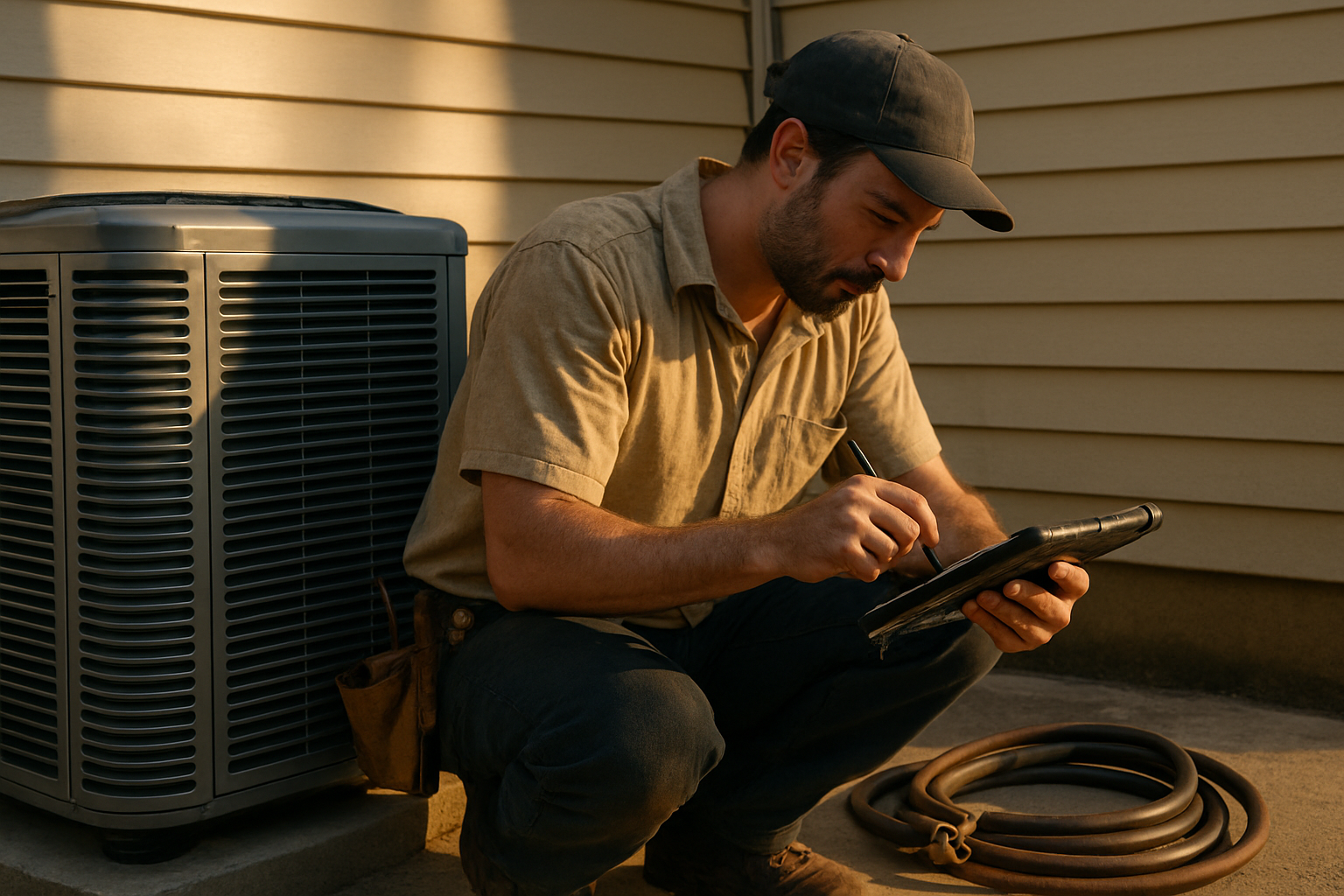
Most solo HVAC techs start out billing hourly because it feels safe — you get paid for every minute you turn a wrench. Then you watch a flat-rate shop charge $185 to swap a capacitor, a job you know takes 25 minutes, and the math stops adding up. The decision between flat rate and time-and-materials for HVAC isn't about picking the better pricing model in the abstract. It's about knowing which one fits which job type — and whether your flat rates are built from your real costs, not from what the guy before you charged. This post covers both models, when each one wins, and how to build a flat rate price list that holds when a call runs long.
What flat rate and time and materials actually mean for HVAC techs
Flat rate means you quote one fixed price before you start, regardless of how long the job takes. Swap a capacitor for $175 — whether you're done in 20 minutes or 50, that number doesn't change. You keep the upside when you're fast. You absorb the loss when something turns complicated.
Time and materials (T&M) means you bill your hourly labor rate plus the actual cost of parts. If a diagnostic call takes 90 minutes and you used $40 in parts, that's what the customer pays. Your margin is protected on unpredictable work; the customer faces an open-ended invoice.
Both models are legitimate. The mistake most solo HVAC techs make is defaulting to one model for every call. HVAC work splits more cleanly than most trades — there are jobs where the scope is obvious before you touch the equipment, and jobs where it genuinely isn't.
Where flat rate wins for HVAC service calls
Flat rate pays better on routine, predictable repairs where your experience gives you a speed advantage over the time you've built into the price. Strong candidates for flat rate pricing in HVAC:
- Capacitor replacement (single or dual-run)
- Contactor swap
- Thermostat replacement (standard 5-wire, non-communicating)
- Annual preventive maintenance tune-up
- Filter replacement and coil cleaning (bundled into a maintenance call)
- Igniter, flame sensor, or pressure switch on a gas furnace
- UV light or whole-home filter installation
On these jobs, a skilled solo tech can often wrap up in 60–70% of the time you've baked into the flat rate. That efficiency margin stays in your pocket. Nobody is billing your time back to the customer.
Flat rate also removes the customer's incentive to watch the clock. They knew the price before you started, so when you finish quickly, they think you're good at your job — not that you rushed. That difference matters for repeat calls and referrals.
Where flat rate bites you: jobs with hidden variables. If you quoted $165 for a thermostat swap and the existing wiring is the wrong gauge for the new stat, or the system uses a proprietary communicating protocol, you're either eating extra time or having an awkward mid-job conversation. The fix is a clear written scope — "this price covers a standard 5-wire non-communicating thermostat replacement; any wiring issues or proprietary systems are billed separately" — not abandoning flat rate for that job type.
Where time and materials is the right call for HVAC work
T&M belongs on any call where you don't know what you'll find until you're in the equipment. In HVAC, that's most diagnostic calls:
- "Not cooling" or "not heating" — cause unknown until you've run through the system
- Refrigerant leak diagnosis, where the source could be anywhere and leak search time is real
- Commissioning a newly installed system with unknown startup issues
- Unfamiliar proprietary or communicating systems (Trane ComfortLink, Lennox iComfort, and similar)
- Commercial RTU work with unclear maintenance history or mixed-brand controls
The diagnostic exception is one of the biggest practical differences between HVAC and most other trades. A plumber called for a clogged drain usually knows what job they're doing before they open the cleanout. An HVAC tech called because "it's running but not cooling" might be looking at a failed capacitor, low refrigerant charge, dirty evaporator coil, bad metering device, or a refrigerant leak — and those jobs are not in the same flat-rate neighborhood.
If you're going T&M, always give the customer a range before you start: "Diagnostic fee is $95 for the first hour, plus parts and additional labor. Most residential calls run $150–$400 total." You're not capping the invoice, but you're anchoring the conversation. That one sentence prevents most billing disputes.
How to set HVAC flat rates that hold
This is where most techs get flat rate wrong. They copy numbers from a flat rate book written for a multi-truck shop, or pull rates from memory, and then wonder why some calls feel profitable and others leave them short.
The right starting point is your floor rate — your minimum hourly rate as a solo operator, calculated from your actual annual costs and target income. The minimum hourly rate formula for solo contractors walks through the full calculation. The key point for HVAC techs: the U.S. Bureau of Labor Statistics reports a median hourly wage of $32.75 for heating, air conditioning, and refrigeration mechanics and installers as of May 2025. That is an employee wage. A solo operator billing residential customers needs to cover their own health insurance, truck payment, tools, EPA 608 certification renewals, liability coverage, and self-employment taxes on top of that — and still turn a profit. Those costs push the practical floor rate for most solo HVAC techs well above $70/hr before profit is even factored in.
Once you have your floor rate, the formula for any flat rate item is:
Flat rate = (floor rate × average job hours) + average materials cost + 15–20% overrun buffer
Example: your floor rate is $80/hr. A single-run capacitor replacement averages 0.5 hours of your time, and your average capacitor cost at the supply house is $18. Your floor cost is ($80 × 0.5) + $18 = $58. Add a 20% overrun buffer: $58 × 1.20 = $69.60. Round to $75 or $79. Your actual market rate is likely higher — check HVAC service call pricing benchmarks to see the regional range and make sure you're not leaving money on the table.
The chart below shows the break-even point between a $165 flat rate and $80/hr T&M billing (labor only, no materials). Jobs under about two hours favor flat rate. Anything that runs longer favors T&M.
Use the markup calculator at JobEstimator to verify that your materials margin is built into each flat rate item. It's easy to price the labor correctly and forget that parts markup matters — especially when refrigerant and supply-house parts costs have shifted significantly over the last few years.
HVAC flat rate vs. T&M by job type
| Job | Flat rate? | T&M? | Notes |
|---|---|---|---|
| Capacitor swap (single or dual-run) | ✓ | — | High-frequency, fast; flat rate pays well |
| Contactor replacement | ✓ | — | Standard parts, predictable labor |
| Thermostat replacement (5-wire standard) | ✓ | — | Scope clear before you start |
| Annual preventive maintenance tune-up | ✓ | — | Known checklist; price as a package |
| Igniter or flame sensor replacement | ✓ | — | Same job every time |
| Refrigerant recharge (known leak source) | ✓ + actual refrigerant cost | — | Flat labor; bill refrigerant at actual |
| "Not cooling" or "not heating" diagnostic | — | ✓ | Cause unknown; T&M protects your time |
| Refrigerant leak search | — | ✓ | Search time varies too widely to flat rate |
| Proprietary or communicating systems | — | ✓ | Quirks and resets eat time unpredictably |
| New system commissioning and startup | — | ✓ | Unknown startup issues |
| Emergency after-hours call | ✓ + premium | ✓ + premium | Either works; flat rate + emergency fee is cleaner |
How to build your HVAC flat rate book as a one-man shop
The most common mistake is trying to build 80 line items at once and abandoning the whole thing before you've used it. Don't. Start with your five most predictable, highest-frequency service jobs — the ones you've done enough times to know your average time and parts cost with real confidence.
A practical rollout:
- Run your floor rate first. You need an actual number before any flat rate item makes sense. Without it, you're guessing.
- Pick your top five jobs. For most solo residential HVAC techs: capacitor swap, contactor swap, thermostat swap, tune-up package, igniter or flame sensor. Write down your actual average labor hours and average supply-house parts cost for each.
- Apply the formula. (Floor rate × avg hours) + avg parts cost + 20% overrun buffer. Round to a clean number.
- Quote flat rate on those five jobs only for 30 days. Track actual time versus your average on every call.
- Review at 30 days. If you're running over on a job type more than once, adjust the price or add a written scope note. Anything that blows up twice moves back to T&M until you understand why.
- Expand by three to five items per month. Within 90 days you'll have a working price book covering your most common residential service work.
The mechanics of building a flat rate book for HVAC are similar to what solo plumbers go through — if you want to see that parallel worked out step by step, flat rate vs. T&M for solo plumbers walks the same transition for a different trade.
Once your price book grows and you're quoting a mix of flat-rate repairs and T&M diagnostics in the same week, a spreadsheet starts to break down. HVAC quoting software vs. spreadsheets covers where dedicated software starts paying for itself.
Takeaways
- Flat rate wins on routine repairs and maintenance where scope is clear before you touch the equipment. T&M wins on diagnostics and any call where you don't know what you'll find until you're in the system.
- The Bureau of Labor Statistics reports a median employee wage of $32.75/hr for HVAC mechanics (May 2025 OEWS). Solo techs billing to customers need a floor rate well above that to cover insurance, truck costs, and self-employment taxes.
- Build flat rates from your floor rate — not from a competitor's price sheet. Their overhead is different from yours.
- The HVAC diagnostic exception is real: most "not cooling / not heating" calls cannot be flat-rated because the cause is genuinely unknown before you start. Keep T&M ready for those.
- Always give T&M customers a verbal price range before you start. "Most calls like this run $150–$400" anchors the conversation and prevents disputes.
Price your next HVAC call before you load the truck
Flat rate or T&M is a decision you make per job, not once for your whole business. Get your floor rate locked in, build a flat rate list starting with your five most predictable service types, and keep T&M in your back pocket for diagnostics and anything with an unknown scope. Once you stop guessing at prices, you stop writing calls that leave money on the table when the job wraps in 25 minutes — and you stop taking losses when a diagnostic runs two hours before you touch a part.
JobEstimator lets you build quotes with both flat-rate and T&M line items in the same document, so you're never forcing a complex diagnostic call into the wrong pricing model. Plans start at $39/mo. Build your first HVAC quote in under five minutes.