Electrician panel upgrade pricing: what to charge in 2026
Electrician panel upgrade pricing made simple: a step-by-step cost breakdown to help you charge the right flat rate for a 200-amp service upgrade.
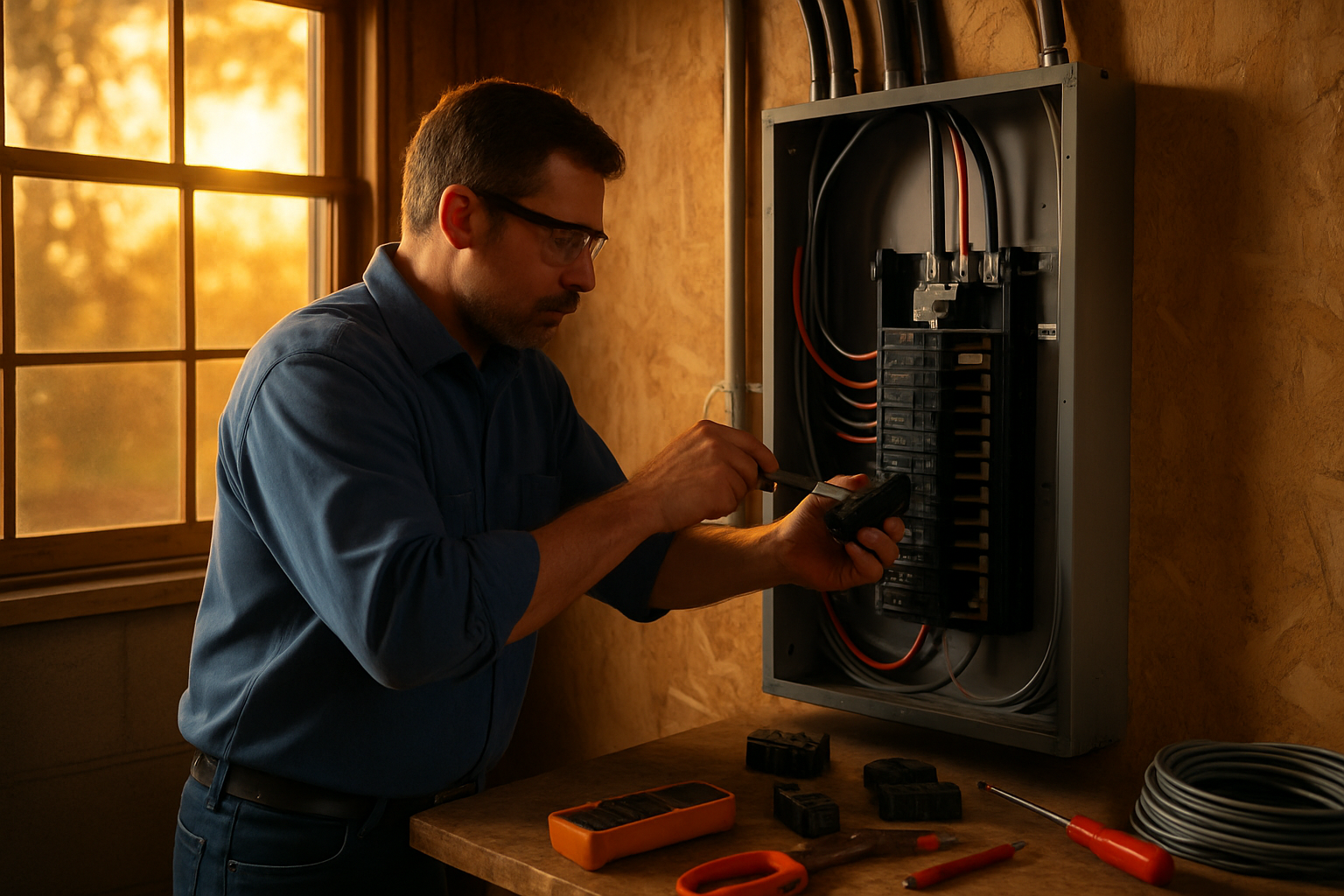
Electrician panel upgrade pricing guides are everywhere online — but most of them are written for the customer. They want to know what to budget before they call you. That's useful for them and useless for you. What you need is a price built from the bottom up: your labor rate, your material cost, the permit fee your local Authority Having Jurisdiction charges, and your markup. Get those four inputs right and the number you quote will be defensible, profitable, and close to what the market will bear — because it's grounded in your actual cost, not a homeowner-site average that mixes union shops, side-work pricing, and regional outliers that have nothing to do with your business.
This post walks through each of the four inputs for a standard 100-to-200-amp residential service upgrade and assembles them into a flat-rate number you can use as a starting point.
What goes into the cost of a 200-amp panel upgrade
Every 200-amp service upgrade has the same four cost components, regardless of the market you work in:
- Labor — your hours on the job, billed at your loaded shop rate
- Materials — the panel, breakers, service entrance conductors, meter socket, grounding hardware, and miscellaneous fittings
- Permits and inspection fees — mandatory in essentially every U.S. jurisdiction for service work
- Overhead and margin — vehicle costs, insurance, tools, business overhead, and the profit that makes this worth doing
The mistake most contractors make — especially newer ones — is skipping to the "total" and working backwards from what competitors charge. That method works until a competitor is pricing at a loss and you start matching them. Build the price forward from your real costs every time.
How to calculate your panel upgrade labor cost
Your labor cost starts with your loaded hourly rate, not the BLS median wage. The U.S. Bureau of Labor Statistics reports a median hourly wage of $34.37 for electricians as of May 2025. That figure tells you what the labor market pays employees — it's not your billable rate as a solo operator.
As a solo electrician, your loaded rate has to cover everything the employer would normally absorb: workers' comp, general liability, vehicle costs, tools, unbillable hours (estimates, drive time, admin), slow weeks, and retirement. If you haven't built a floor rate from your actual overhead, work through the formula in How to Calculate Your Minimum Hourly Rate as a Solo Contractor before you quote another job. Most solo electricians find their loaded rate lands between $75 and $105 per hour before adding a profit layer on top.
Once you have your loaded rate, the next question is hours. A straightforward 100-to-200-amp upgrade — same panel location, a utility that cooperates on the disconnect window — typically runs 6 to 10 labor hours for one electrician. The NECA Manual of Labor Units, the industry-standard estimating reference used by electrical contractors nationwide, places residential service changes in this range for standard conditions. Complications extend that time substantially:
| Job condition | Typical labor hours |
|---|---|
| Straight swap, same location, cooperative utility | 6–8 hrs |
| Upgrade with meter relocation | 10–14 hrs |
| Full overhead service change (new mast, riser, utility coordination) | 12–18 hrs |
| Panel with aluminum feeders or unknown wiring vintage | Add 2–4 hrs |
At $90 per hour and 8 hours of labor, your labor cost for a standard upgrade is $720. That's not your price — it's your labor input before materials, permit, and markup.
How to price materials for a panel upgrade
The typical material list for a 200-amp service upgrade includes:
- Main panel (200-amp, 20–40 space): varies by brand and space count
- Circuit breakers to populate the new panel
- Service entrance conductors (2-2-2-4 aluminum SEU cable or THWN in conduit for longer runs)
- Meter socket if the existing one is being replaced
- Grounding electrode conductors and hardware
- Miscellaneous fittings — connectors, straps, weatherhead, lockout hardware
Pricing for these items varies by region, current copper and aluminum commodity prices, and your supply house relationship. Check distributor pricing on a standard 200-amp, 24-space main panel from Square D, Eaton, or Siemens — you'll know the current number better than any website can tell you.
What doesn't vary is the method: quote materials at your cost plus markup. Don't absorb markup into your labor rate and don't forget it on small items. The markup calculator lets you verify that the markup percentage you're applying actually produces the gross margin you intend — a 40% markup, for example, is only a 28.6% gross margin. Whether that's the right target for your business depends on your overhead structure, but the math is worth running before you lock in a number.
If your materials cost $620 on a given job and you apply a 40% markup, you bill $868 for that line. That difference covers overhead attributable to procurement, supplier relationship, and the carrying cost of having materials on your truck or at the supply house the morning of the job. It's not free money — but it is margin that belongs on your quote.
Permit and inspection fees: the line item that can't be hidden
Every 200-amp service upgrade requires a permit in virtually every U.S. jurisdiction. The National Electrical Code (NFPA 70) governs service installation requirements, and local Authorities Having Jurisdiction enforce compliance through the permit and inspection process.
Permit fees vary widely:
- Smaller municipalities and rural jurisdictions: $75–$175
- Mid-size cities: $150–$350
- High-cost metro areas (parts of California, New York, the Washington DC area): $350–$700 or more
Before quoting a panel upgrade in a jurisdiction you haven't permitted before, call the local building department and ask for their residential electrical permit fee schedule. Five minutes on the phone saves you from absorbing a $400 permit you priced at $150.
Always pass permit fees through at cost on a separate line item in your written quote. A customer who asks why there's a permit fee is easier to educate before the job than after. Never roll permit costs into your overhead estimate — that makes your rate look higher without explaining why, and it removes a line item that customers recognize as non-negotiable once you name it clearly.
Should you quote a panel upgrade as flat rate or hourly?
For standard 200-amp upgrades you've done before, flat rate wins. The job is scoped, your hours are predictable, and the customer gets price certainty up front. For the full model comparison and the math behind when each one protects you, see Flat rate vs. time and materials pricing for solo electricians.
The exception: use time-and-materials with a not-to-exceed cap when the scope genuinely can't be locked down. Aluminum wiring throughout the panel circuit, a Federal Pacific or Zinsco panel requiring extra remediation work, or a utility that can't confirm a disconnect date until the week of the job — these add hours that are hard to predict in advance. A T&M quote with a written cap protects both you and the customer, and the cap document also becomes your protection if the customer disputes the hours later.
A reasonable not-to-exceed cap for a panel upgrade with real unknowns: take your flat-rate estimate, add 25–30%, and document in the quote what would trigger the cap to become relevant. That's professional estimating, not hedging.
Electrician panel upgrade pricing: a worked example
Here's how the four inputs stack up on a typical residential upgrade in a mid-cost market. Every line needs to be adjusted to your actual cost and location.
| Line item | Your cost | Billed amount | Notes |
|---|---|---|---|
| Labor: 8 hrs × $90/hr | $720 | $720 | Margin is embedded in your rate |
| Panel, breakers, hardware | $500 | $700 | 40% markup |
| Service entrance conductors + misc | $120 | $168 | 40% markup |
| Permit and inspection | $200 | $200 | Pass-through at cost |
| Total quote | $1,540 | $1,788 |
At $1,788, this is a flat-rate quote for a standard job. In practice, panel upgrade quotes range from $1,500 to $3,000 or more depending on your market, your loaded rate, job complexity, and local permit costs. Contractors near the bottom of that range are typically not covering overhead in their labor rate — they're using the employee-wage math and racing to the bottom. Don't compete on their terms.
If this range looks low for your area, it's worth checking whether your service call rate is also running under market. Panel upgrade pricing and service call pricing tend to track together — if you're undercharging on the hourly calls, you're likely undercharging on the larger jobs too. See Electrician Service Call Pricing: What to Charge in 2026 for the floor-rate comparison.
Takeaways
- The BLS median electrician wage of $34.37/hr (May 2025) is your employee-market benchmark, not your billable rate — your loaded shop rate as a solo operator needs to clear $75–$105/hr to cover overhead before you add any profit.
- A standard 100-to-200-amp residential upgrade runs 6 to 10 labor hours under normal conditions; relocations, utility delays, and older wiring will push that number higher in ways you need to scope before you quote.
- Pass permit fees through at cost on a separate line item — never absorb them — and call your local AHJ before quoting in a new jurisdiction.
- Mark up materials using a consistent percentage; a 40% markup produces a 28.6% gross margin — run your own overhead numbers to find the right target for your shop.
- Flat-rate pricing works well on panel upgrades you've done before; for jobs with real unknowns, use time-and-materials with a written not-to-exceed cap.
Price your next panel upgrade before the customer calls someone else
Panel upgrade customers typically request quotes from two or three electricians. If you can get a professional, itemized quote back in under an hour, you're ahead of most of your competition before the phone stops ringing.
JobEstimator builds the labor, materials, markup, and permit line items automatically from a short job description — so your panel upgrade quote is ready in minutes. Plans start at $39/mo, and the markup recovery on a single average panel job more than covers it. Before your next quote goes out, run your markup numbers through the free markup calculator to make sure the margin you think you're making is the margin you're actually keeping.