Carpet installation labor cost per square foot: 2026 rate guide
A contractor's rate guide to carpet installation labor costs in 2026: per-square-foot and per-yard benchmarks, job modifiers, and minimum-charge rules.
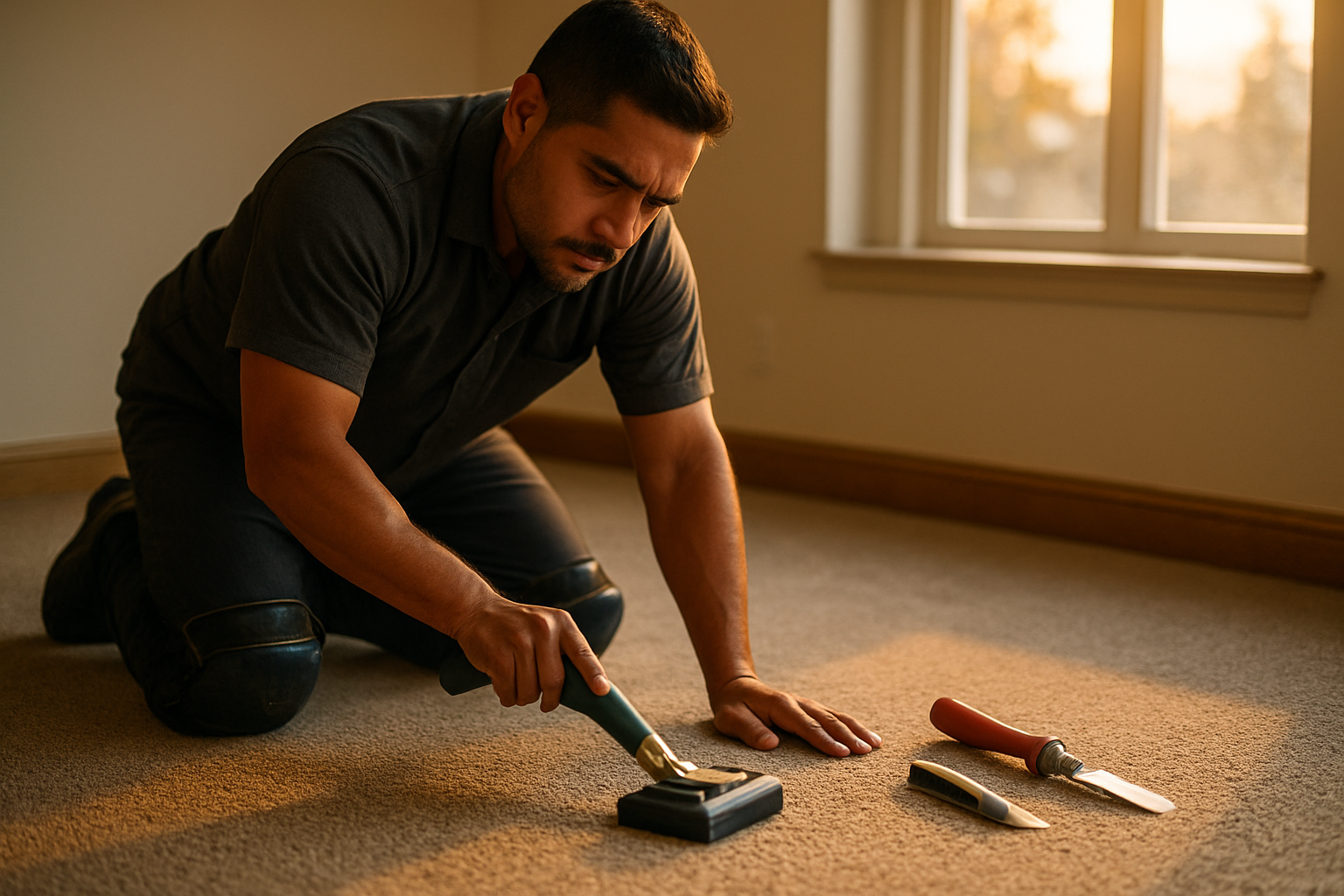
Figuring out what to charge for carpet installation used to mean calling around to see what competitors were quoting. Most benchmarks you find online target homeowners — total project cost including materials — which doesn't help when you're pricing labor only or building a per-square-foot rate from the ground up. This guide gives you 2026 carpet installation labor cost benchmarks by scope, shows you how to build your rate from U.S. Bureau of Labor Statistics wage data, and flags the job conditions that should move your price up or down.
Carpet installation labor cost per square foot in 2026
Standard residential carpet installation labor runs $1.00 to $2.50 per square foot for a typical bedroom scope that includes cutting, stretching, and trimming over a new pad. HomeAdvisor's 2026 national cost data reports that homeowners pay $0.50 to $2.00 per square foot for labor alone — which gives you a real-world floor on what the market will support.
Add scope, and the number rises quickly:
| Scope | Labor rate (per sq ft) | What's included |
|---|---|---|
| Commercial (large area, low-pile) | $0.75 – $1.75 | Stretch-in only, flat layout |
| Labor-only residential | $0.50 – $1.50 | Tack strip already set, no pad supplied |
| Standard residential with pad | $1.25 – $2.50 | New pad, stretch-in, trim to baseboard |
| Full-service (removal, furniture move, new pad) | $2.50 – $4.50 | Full day's scope |
| Stairs | $10 – $25 per step | Cut, wrap riser, seam, staple |
One thing worth running the numbers on: a 2,000 sq ft commercial carpet job at $1.25/sq ft grosses $2,500. A 700 sq ft full-service residential job at $3.75/sq ft grosses $2,625 and might take half the time. Scope matters as much as size.
Per yard vs per square foot: which unit should you quote?
Carpet is manufactured and sold by the square yard (1 sq yd = 9 sq ft), so many installers have historically quoted by the yard. As labor-only installs became more common — the homeowner buys carpet at retail, you provide the installation — quoting per square foot lines up better with how customers measure rooms and how you write the scope of work.
A simple rule: if you're supplying carpet and pad, quote per yard so material markup is easier to track. If you're labor-only, quote per square foot because customers likely measured in feet and can verify the number against their own measurement.
Either way, know the conversion before you walk into a job. A $1.75/sq ft rate equals $15.75/sq yd. A competitor quoting $14.00/sq yd looks $1.75 cheaper on the surface; at $1.56/sq ft, they're actually charging $0.19/sq ft less. Customers who shop multiple quotes will do this math, so make sure you can too.
Our flooring labor rate guide covers LVP, hardwood, and tile comparisons if you install multiple flooring types.
How to build your carpet installation rate from the ground up
Picking a rate from a table is a useful reality check. Building your own rate from actual costs is what protects your margin when materials prices shift or the job takes longer than expected.
1. Start with the BLS wage floor.
The U.S. Bureau of Labor Statistics May 2025 Occupational Employment and Wage Statistics puts the national median hourly wage for Carpet Installers (SOC 47-2041) at $24.20 per hour. This is the employee rate — it excludes the employer's payroll taxes, workers' comp, health insurance, and any overhead. As a self-employed installer, your billing rate has to cover all of that before you get to profit.
2. Apply a burden multiplier.
Self-employed installers pay both sides of FICA (15.3%), plus liability insurance, vehicle costs, tool replacement, and licensing. A realistic burden rate runs 45–60% on top of the base wage. At the BLS median: $24.20 × 1.55 = $37.51 per hour as a fully burdened cost of labor.
3. Estimate your job productivity.
A solo installer doing standard residential stretch-in can typically cover 80–120 square yards (720–1,080 sq ft) per day in an eight-hour shift — roughly 90–135 sq ft per hour under average conditions. Tight spaces, pattern matching, or heavy furniture slow that number; a large open commercial floor speeds it up.
4. Divide cost by productivity to find your floor.
At $37.51/hr and 100 sq ft/hr: $37.51 ÷ 100 = $0.38/sq ft in fully burdened labor. Add a 50% gross margin ($0.38 ÷ 0.50 = $0.76/sq ft) and you have your labor floor before overhead.
5. Layer in fixed overhead.
Your monthly truck payment, insurance, storage, and licensing divide across your billable hours. Use the markup calculator to convert your fixed overhead into a per-square-foot add-on. For most solo installers running 30–40 billable hours per week, this adds $0.25–$0.70/sq ft — landing the total at $1.00–$1.50/sq ft for a straightforward residential flat-lay. Anything complex — stairs, furniture, removal — is priced on top of this.
Job conditions that move the price
Once you have a base rate, adjust for these scope factors:
-
Stairs: Every step is its own mini-job. Cutting the tread, wrapping the riser, and stapling clean seams without bunching takes 8–15 minutes per step. Working that against the $37–$45/hr fully burdened rate from the calculation above, you land at $5–$11 in labor cost per step. Market pricing of $10–$25/step reflects that cost plus overhead and margin.
-
Old carpet removal: Pull, roll, and haul old carpet at $0.25–$0.60/sq ft, depending on pad adhesion and whether staples are involved. Tack strip replacement runs $0.10–$0.25 per linear foot.
-
Pad supply: If you're supplying pad, quote it as a separate materials line with your markup. Rolling pad into a single per-foot rate hides your margin and makes you look expensive against a competitor who quotes labor-only.
-
Pattern repeat: Carpet with a 12-inch-or-larger pattern repeat creates cutting waste at every seam. Add $0.20–$0.50/sq ft for the extra trim time and material loss.
-
Concrete subfloor: Wood subfloors in remodels usually have tack strip already. Concrete requires power-nailing new strip — budget an additional $0.15–$0.25/sq ft for labor and material.
-
Furniture moving: Quote as a flat fee ($75–$150 depending on room size) rather than folding it into your per-foot rate. It keeps the numbers transparent and avoids arguments about what "full-service" includes.
Setting a minimum charge for small carpet jobs
A 150 sq ft hallway at $1.75/sq ft grosses $262.50. After loading your van, driving to the site, and spending two hours from start to cleanup, you've used half a morning to earn what might not cover your truck cost.
Set a minimum charge before someone calls you for 80 square feet:
- Add up your daily fixed costs: vehicle, insurance, and the fully burdened cost of your labor for an eight-hour day.
- Divide by the minimum acceptable job time — typically 3 hours.
- The result, often $275–$450 for a solo installer, is your minimum charge.
State it on your estimate template. Customers who see it will either book a scope worth your time or take the small job elsewhere. Both outcomes are better than a half-day where you clear $15/hr after costs.
Takeaways
- The U.S. Bureau of Labor Statistics May 2025 data (SOC 47-2041) puts the national median hourly wage for carpet installers at $24.20/hr; self-employed installers need to bill 2.5–3× that to cover overhead and profit.
- Standard residential carpet installation with pad runs $1.25–$2.50/sq ft for labor in most U.S. markets; full-service scopes with removal run $2.50–$4.50/sq ft, per HomeAdvisor's 2026 national data.
- Stairs are priced per step ($10–$25), not per foot — always list them separately on your quote.
- Whether you quote by the yard or by the foot, know the conversion cold: $1.75/sq ft = $15.75/sq yd.
- Set a minimum charge — typically $275–$450 for a solo operator — to keep small jobs from draining your schedule.
Quote carpet installations faster
JobEstimator generates itemized carpet quotes in a few minutes: enter room dimensions, select scope, enter your per-foot rate and minimum charge, and it builds a professional line-item quote you can text or email before you leave the driveway. Plans start at $39/mo with no long-term commitment. If you're spending more than 15 minutes building out a quote for a job you could close in one phone call, the tool pays for itself in the first week.