Deck building labor rates: what to charge per square foot in 2026
What deck contractors charge per square foot in 2026, how BLS carpenter wages and complexity factor into your rate, and how to protect margin on every build.
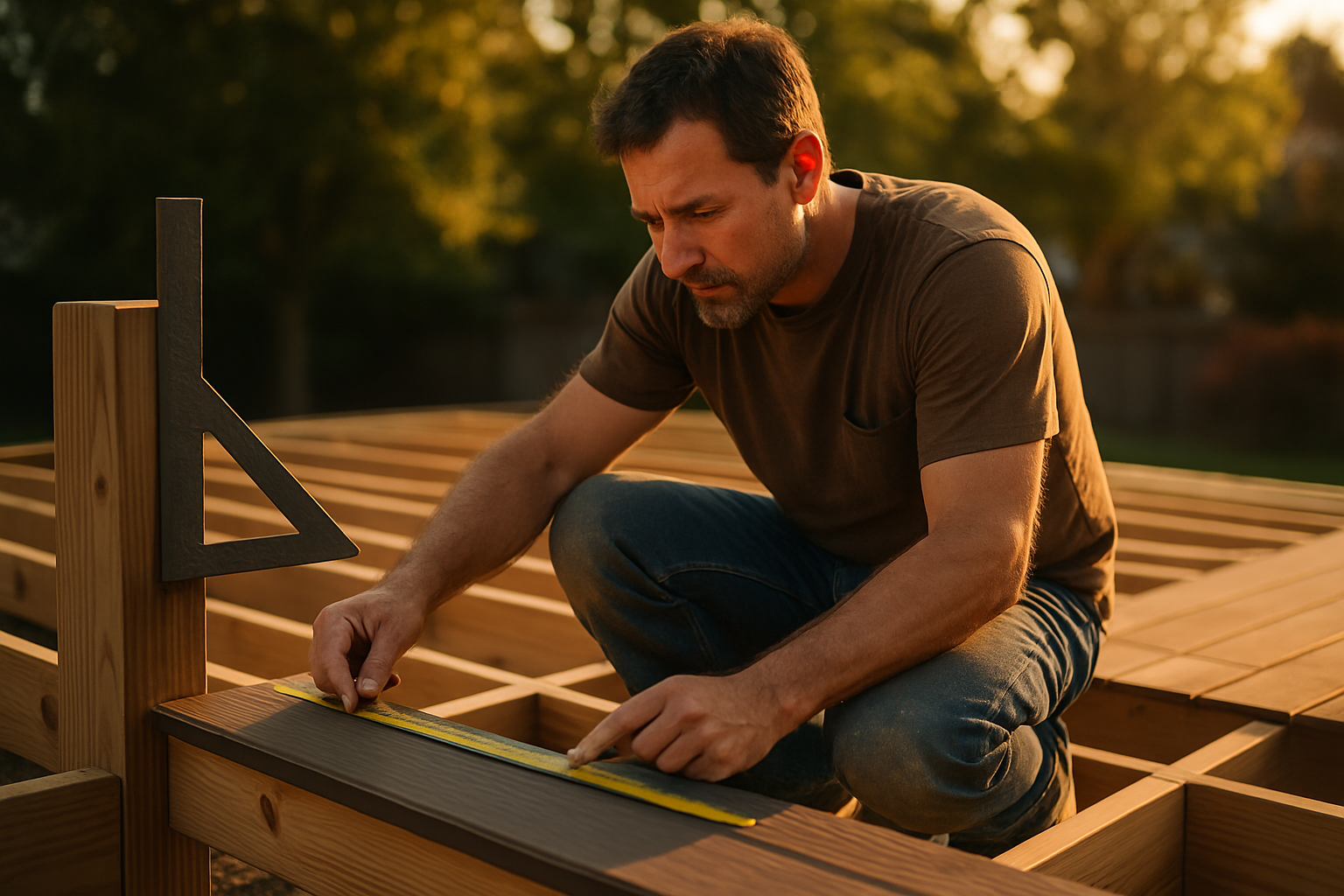
Most of what you find when you search for deck labor cost per square foot is written for homeowners planning a budget. Those guides bundle your labor, materials, equipment, overhead, and markup into a single all-in number that won't tell you whether your current rate covers your costs or whether you're leaving money on the table with every bid.
This guide is written from the contractor side: what deck builders are actually charging for labor in 2026, how material type and job complexity move that number, and how to build a floor rate from real carpenter wage data so your quotes hold up before you're standing in someone's backyard.
What deck contractors are charging per square foot in 2026
According to Angi's 2026 deck cost data, professional deck installation labor runs $15–$35 per square foot across most residential projects. Complex and elevated work — multi-level platforms, second-story structures, curved perimeters — regularly pushes past that ceiling into the $40–$50 range.
Here is how the market breaks down by job type:
| Job type | Labor per sq ft | Notes |
|---|---|---|
| Simple ground-level deck | $15–$22 | Rectangular PT wood, basic footings, no guard rail required |
| Standard elevated deck | $20–$30 | Code-depth footings, guard rail, ledger attachment to house |
| Multi-level or complex deck | $28–$40+ | Additional framing tiers, stairs, angled boards, elevated footings |
These are national averages. High-cost markets — the Northeast corridor, Bay Area, Pacific Northwest — routinely run 20–30% above these ranges. Rural Southeast and Midwest markets tend to land at or near the low end of each band. The ranges show you where the market sits; your floor rate tells you whether the market rate actually covers your costs.
How material type shifts your labor rate
The decking material going in changes how long installation takes — and that changes what you should charge, even on jobs with identical square footage and the same structural framing design.
Pressure-treated lumber is the baseline. Boards are lightweight, cut predictably with standard carbide blades, and face-fasten efficiently with structural screws or ring-shank nails. Most deck carpenters built their pace and sense of per-hour output on PT lumber. If your rate card was built on years of PT work, it's probably well-calibrated for that material and weaker for everything else.
Composite and PVC decking takes meaningfully longer per square foot in a hidden-fastener layout. Individual clips install board-by-board, require precise spacing to maintain consistent gaps as the boards acclimatize, and can't be driven at the same pace you'd run face fasteners. Most composite manufacturers specify fastener patterns and allowable span requirements you need to verify before framing — adding low-value time to the front end of the job. Account for the extra hours before you quote composite work, not after you've already bid the job at your PT rate.
Tropical hardwoods such as ipe, teak, and cumaru are dense enough to require pre-drilling virtually every fastener hole to prevent splitting. Standard carbide blades dull faster on tropical wood than on PT or composite, and specialty stainless or hidden fasteners are the norm rather than the exception. The labor cost per square for tropical hardwood installs runs higher than PT rates for reasons that compound: pre-drilling adds time, blade wear adds consumable cost, and the material demands a slower, more deliberate pace. If you haven't tracked your drill bit and saw blade replacement frequency on hardwood jobs, this is likely where margin is leaking.
Before your next composite or hardwood quote, run your labor line through the free markup calculator to confirm the rate you're charging accounts for the additional time.
Complexity factors that push your per-square-foot rate higher
Beyond material type, four job-specific variables account for most of the spread between a $15/sq ft deck and a $38/sq ft deck — even on structures that look similar on paper.
1. Height above grade. A ground-level deck under 18 inches has no guard-rail requirement in most jurisdictions and can use surface pads or short post footings in areas with mild winters. A deck 6 feet off the ground requires engineered footings, full guard rail with balusters and top rail, potentially a beam upgrade, and the added time and care of working at height. The framing process is similar — the code requirements, staging, and fall-protection setup are not.
2. Footing type. In freeze-climate states, footings must extend below the frost line — which in the Midwest and Northeast means drilling or digging to 36–48 inches. That involves a post-hole digger or concrete drill rental and waiting for concrete cure before framing begins. Surface pads in mild climates cost a fraction of that in both labor and equipment. Know your local frost depth and confirm footing requirements with the building department before pricing a job in an unfamiliar county.
3. Ledger-attached vs. freestanding. A ledger attachment requires correctly flashing the ledger into the home's water-resistive barrier — a detail that carries real liability if the flashing fails and water gets into the wall. Code enforcement on ledger connections has tightened in most jurisdictions. Freestanding decks avoid ledger liability but need more post footings to reach structural independence. Neither design is universally faster; both add scope that a simple square-footage estimate doesn't capture without looking at the structural drawings.
4. Stairs, built-in benches, and pergola framing. A single stair run — stringers, treads, risers, balusters, and handrail — can add 4–8 labor hours by itself on a standard 12-step run. Built-in benches and planters are time-intensive even when the materials are simple. Pergola framing bolted to the deck posts doubles the complexity of the post-and-beam layout. Quote these features as separate line items rather than absorbing them into your per-square-foot rate. Line items protect your margin and make it clear to the customer what each feature actually costs.
Building your deck labor floor from BLS wage data
The U.S. Bureau of Labor Statistics' May 2025 Occupational Employment and Wage Statistics reports a median hourly wage of $29.12 for carpenters. That is the labor market input — it is not your billing rate, and it is not your per-square-foot cost.
Your real cost per billed labor hour runs above $29.12 for three reasons that don't appear in the BLS number:
Workers' compensation and payroll burden. Employer FICA contributions run 7.65% on top of wages. Federal and state unemployment taxes (FUTA/SUTA) add another 3–6%. Workers' compensation premiums for carpentry classifications vary by state and loss history but add a meaningful cost on top of the base wage. When you total it up, burden commonly adds 25–35% to the raw wage cost — meaning every $30/hr of labor costs you $37.50–$40.50 before a fastener goes in.
Non-productive time. Your crew is on the clock for the full work day, not only the hours when boards are being set. Material delivery waits, permit inspection holds, tool setup and cleanup, and normal breaks all reduce how many square feet your crew produces per paid hour. How many productive square feet does your crew actually install per hour on a standard job? That number — tracked over real jobs, not estimated in advance — is what belongs in your rate calculation.
Overhead. Truck, trailer, tools, liability insurance, licensing, and business administration divide across every hour you bill. Volume varies, but the overhead line is never zero on any job you do.
Here is how the floor-rate calculation looks for a solo operator on a standard PT ground-level deck:
| Input | Example |
|---|---|
| Base wage (solo carpenter) | $30/hr |
| Burden (WC + FICA + FUTA/SUTA, ~35%) | +$10.50 → $40.50/hr |
| Productive sq ft per hour (PT wood, simple layout) | 4 sq ft/hr |
| Raw labor cost per sq ft | $40.50 ÷ 4 = $10.13/sq ft |
| Overhead per sq ft ($1,200/mo ÷ 500 sq ft billed/mo) | $2.40/sq ft |
| Labor floor before profit | $12.53/sq ft |
| 25% markup on cost (targets ~20% gross margin) | +$3.13/sq ft |
| Labor line in your quote | ~$15.66/sq ft |
That $15.66 lines up with the low end of Angi's national range for a simple ground-level deck, which makes sense for a solo operator at median carpenter wages with lean overhead. If your rate card puts you below your calculated floor, you're absorbing cost somewhere in the job — usually in unbilled time or untracked overhead.
For the full methodology behind that floor calculation, including how to set overhead allocation and what to do when your floor exceeds the local market rate, see How to calculate your minimum hourly rate as a solo contractor.
If you're putting together your first structured deck proposal and want to see how footings, framing, decking, and railings come together in a complete written estimate, How to write a deck estimate covers the full scope breakdown from post footings through railings and hardware.
Takeaways
- Market labor rates for deck installation run $15–$35 per square foot for most residential projects per Angi's 2026 data; elevated and complex work pushes past $35.
- Material type shifts your hours: composite hidden-fastener installs and tropical hardwoods both take more time per square foot than pressure-treated lumber — account for the difference before sending the quote, not after.
- BLS reports a median carpenter wage of $29.12/hr as of May 2025; your billing rate needs to cover payroll burden (~25–35% above the base wage), overhead, and profit on top of that number.
- The four biggest complexity drivers are height above grade, footing type, ledger vs. freestanding design, and stairs and built-ins — quote these as line items, not absorbed into the flat per-square-foot rate.
- Build your rate from actual cost: (wage × burden factor) ÷ productive sq ft per hour, then add overhead and your target markup. If you haven't done that calculation, your rate card is an educated guess.
Price your next deck job before someone else does it cheaper
Most deck contractors lose margin in the same two places: quoting elevated or complex jobs at the same flat per-square-foot rate as a simple ground-level rectangle, and quoting without a floor rate that accounts for burden and overhead.
JobEstimator lets you set your labor floor and markup once, then generate a professional deck estimate in minutes with complexity factored in — no redoing the math on every call. Plans start at $39/mo. Before your next estimate appointment, run your target labor rate through the markup calculator and confirm the gross margin you're quoting is the one you'll actually keep.