Furnace replacement pricing for HVAC contractors in 2026
Furnace replacement pricing for HVAC contractors in 2026: how to build a flat-rate quote that covers labor, equipment markup, permits, and disposal.
Furnace replacement pricing catches a lot of HVAC contractors off guard. The job looks straightforward — swap the box, connect the gas and electrical, button it up — but equipment cost is substantial, installs run longer than expected, and the permit fee is easy to forget when you're quoting fast. Underprice a furnace replacement and a six-hour job wipes out the margin you thought you had. This guide gives you a repeatable framework: the five line items that belong in every furnace replacement quote, how to anchor your labor to the actual job scope, and sample flat rates for the three scenarios you'll run into most.
The five line items every furnace replacement quote needs
A furnace replacement flat rate isn't a single number you pull from memory. It's five cost buckets, added together and marked up to cover your overhead and profit. Miss any one and you're subsidizing the job.
-
Furnace unit — your wholesale cost from your distributor, marked up to your target gross margin. The markup should reflect your actual overhead structure, not what you think the customer expects to pay. If you're unsure where your markup percentage lands relative to your actual gross margin, run it through the markup calculator before you quote — markup and margin are not the same number, and confusing them is one of the most common ways contractors undercharge on equipment.
-
Labor — your billable hourly rate multiplied by your estimated hours for this specific job scope. The time estimate isn't a gut feeling; there's a way to anchor it systematically, covered in the next section.
-
Installation materials — gas piping fittings, furnace connector, flue pipe or PVC venting sections, an electrical whip, and miscellaneous sealants, straps, and sheet-metal work. For a standard same-location swap on an existing system, materials typically run $100–$250. Upgrading to a high-efficiency condensing unit adds PVC combustion air and exhaust pipe, a condensate trap, and sometimes a new drain line, pushing materials to $300–$500 or more depending on the venting run length.
-
Permit fee — the mechanical permit, pulled by you and billed to the customer as its own line item. Don't absorb it.
-
Haul-away and disposal — disconnecting, staging, loading, and hauling the old unit takes time and sometimes a disposal fee. This is not free labor.
Check all five on every furnace quote you write. If you're quoting from memory and can't recall whether you included the permit, add it.
How long does a furnace replacement take? Your time anchor for labor
Your time estimate is the first input in your labor calculation, and it varies more than most contractors price for.
A standard same-location swap — identical furnace footprint, existing ductwork transitions stay, existing gas and electrical connections are compatible — typically runs four to six hours for a solo technician. That's the clean scenario.
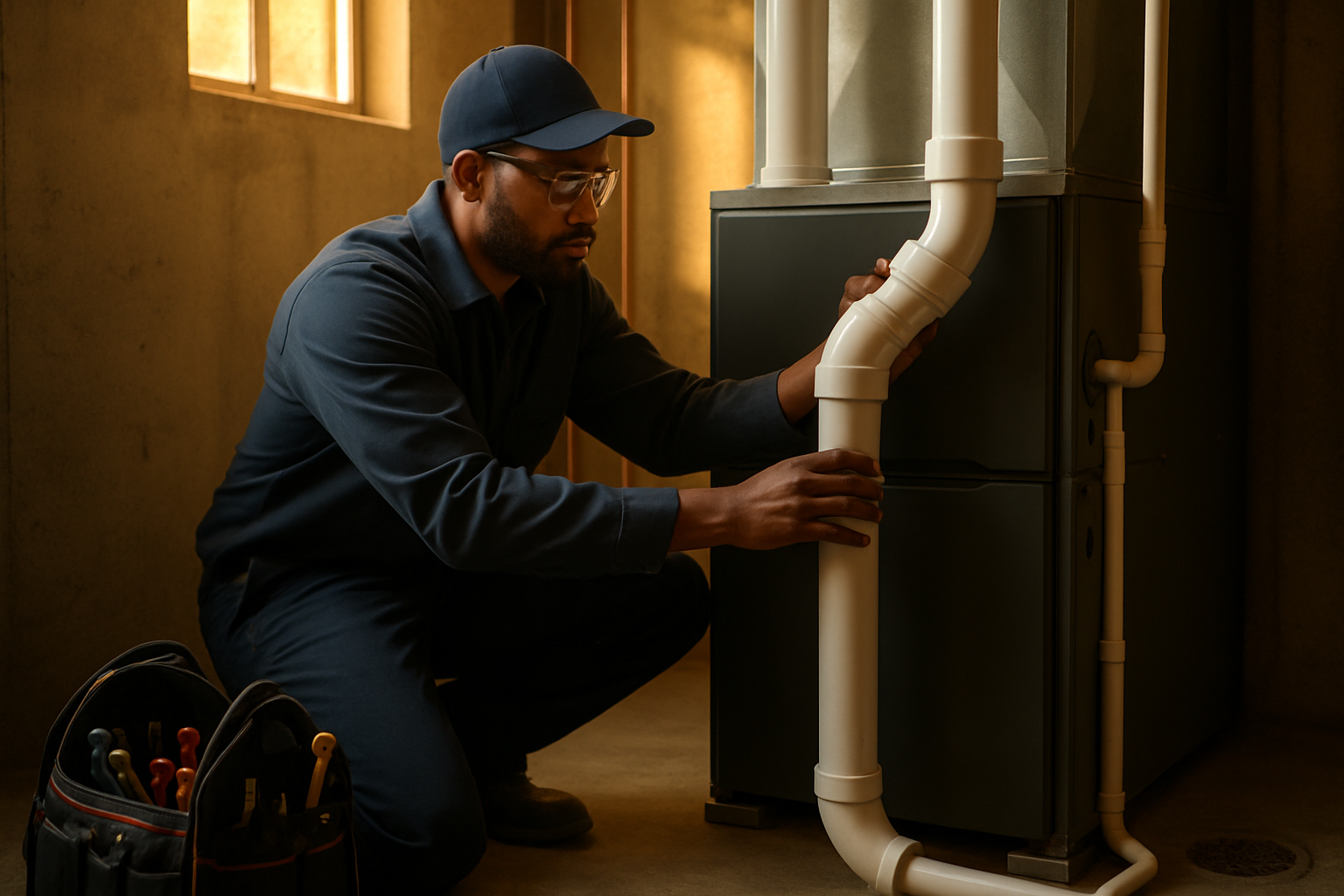
Step up to a high-efficiency condensing furnace (90%+ AFUE) replacing a standard 80% AFUE unit and you're looking at a different scope: new PVC combustion air intake and exhaust venting, a condensate drain line, and frequently a dedicated electrical circuit. Experienced HVAC installers consistently report these jobs running seven to ten hours, and up to twelve when the venting route is circuitous or the mechanical room is tight.
Two other reliable time killers:
- Difficult access — attic, crawlspace, or closet installations add two to four hours over a basement install
- Ductwork modifications — if the transition plenum doesn't line up, the supply or return collar sizing is wrong, or the existing flue connection is incompatible with the new unit, add time before you've touched the new box
The rule: don't quote a furnace replacement on a single assumed time. Confirm installation scope during the site visit. If scope changes mid-job, use a written change order rather than eating the extra hours.
The same time-anchor methodology applies to AC jobs — see AC replacement pricing for HVAC contractors for how we break down cooling-side installs.
Calculating your loaded labor rate
Your billable rate is not your technician's hourly wage.
The U.S. Bureau of Labor Statistics reports a median wage of $28.75 per hour for heating, air conditioning, and refrigeration mechanics and installers (May 2024 Occupational Employment and Wage Statistics). If you're paying at or near that median, your actual cost to put that technician on a job is higher — the IRS requires employers to match 7.65% of wages in Social Security and Medicare taxes alone (per IRS Topic 751), and workers' compensation insurance, health benefits, and a proportional share of vehicle and tool expenses add more. A realistic all-in burden on a $28.75 base wage often runs $40–$45 per loaded hour.
From there, layer in your monthly fixed overhead — insurance, licensing, dispatch, office costs — divided by your available billable hours per month to get an overhead contribution per hour. Add your target net margin on top of that.
Many residential HVAC contractors find that a billable rate of $90–$130 per hour is where the math works for their market, with the higher end applying in high-cost-of-living areas or where EPA 608 certification or specialized equipment commands a premium. That's not arbitrary — it's the result of building up from real costs.
Here's what a sample standard-swap quote looks like when you line up all five items: equipment at contractor cost of $1,200 marked up 50% to $1,800; 5.5 hours of labor at $110 per billable hour totaling $605; installation materials at $180; permit at $185; disposal at $90. Total: $2,860.
Equipment dominates because that's where the capital goes. Labor, even at a proper billable rate, represents just a fifth of the total on a standard swap — which is why underestimating install time hurts less than underpricing equipment markup, but both matter.
The loaded-rate logic here runs parallel to HVAC service call pricing — the only difference is the number of hours you're multiplying against.
Furnace replacement pricing: three job types, three price tiers
Here are the three scenarios you'll price most often, with flat-rate ranges built from all five cost line items. These assume a mid-range residential furnace unit, a billable labor rate in the $100–$120 per hour range, and permit costs on the lower end of local norms. Your numbers will shift based on your actual wholesale cost, your local labor rate, and your authority having jurisdiction's (AHJ) permit fee.
| Job type | Scope | Typical flat-rate range |
|---|---|---|
| Standard swap — same location | 80% AFUE, existing venting, compatible gas and electrical connections | $2,800 – $3,800 |
| High-efficiency upgrade | 90%+ AFUE condensing, new PVC venting, condensate drain added | $4,200 – $5,800 |
| Complex install | Attic, crawlspace, or closet location; ductwork mods; difficult access | Add $600 – $1,500 to either scenario above |
Use these ranges as a sanity check against your calculated quote — not as a substitute for calculating. If your number lands significantly outside the range, find the reason: higher wholesale cost, a higher local labor rate, or a more complex AHJ permit structure. That's fine as long as you know why.
The gap between a standard and a high-efficiency job in this table isn't only the unit price difference. It's also two to four additional labor hours and $200–$400 in extra PVC venting materials. Quote the upgrade as the different scope it is, or you'll give away that margin on every condensing unit you install.
Permits and disposal: the two costs that shrink your margin
Two items contractors most often either forget entirely or quietly absorb.
Per PermitFlow's 2026 HVAC Permit Guide, residential furnace replacement permits typically cost $50 to $500, with most jurisdictions landing between $100 and $300. The wide range reflects local AHJ variation: some municipalities charge a flat fee for a furnace permit; others base the fee on project value or BTU capacity. A few require a separate inspection fee on top of the permit.
Whatever the local cost: pull the permit, show it as its own labeled line on the invoice, and collect it from the customer. When permit cost is visible and clearly labeled, customers understand it's a government pass-through, not margin padding on your labor. Burying it in your labor rate invites the wrong conversation when someone asks for a breakdown.
For disposal, plan to disconnect, stage, load, and haul the old unit yourself or coordinate with a local hauler. Metal recycling facilities often accept old furnace units at low or no cost, but the time to disconnect and stage the unit is real and should be in your labor estimate. If you use a hauler, factor that fee in as its own line.
The permit-plus-disposal combination typically adds $200–$400 to the job total. On a $3,200 quote, forgetting both is an 8–12% margin hit before you've turned a wrench.
After you've completed the replacement, a maintenance agreement is a natural offer while the customer is still in the mindset of investing in their HVAC system — see how to price an HVAC maintenance agreement as a solo tech for how to build that offer.
Takeaways
- A furnace replacement quote has five line items: unit, labor, installation materials, permit, and disposal. Missing any one directly reduces your margin.
- Standard same-location swaps typically run four to six hours. High-efficiency condensing upgrades typically run seven to ten hours. Verify scope on-site before committing to a time estimate.
- Your billable rate is built up from your loaded tech cost plus overhead plus target margin. The BLS reports a median HVAC tech wage of $28.75 per hour (May 2024); that's your cost input, not your billing rate.
- The high-efficiency upgrade is a meaningfully different job: two to four extra labor hours, $200–$400 in additional PVC venting materials, and a higher unit cost. Quote it as such.
- Permit fees run $50–$500 depending on your AHJ — bill them as a separate line item every time.
Get furnace replacement quotes out faster
Building these five line items from scratch every time is slow, and slow quoting costs jobs. If you're still writing furnace replacement quotes by hand or on a spreadsheet, you're also carrying the margin risk that comes from mental math under pressure.
JobEstimator is built for HVAC contractors who want to send accurate flat-rate quotes before they leave the driveway. You enter the job scope, the tool calculates equipment markup, labor, materials, permit, and disposal, and a professional quote goes to the customer in minutes. Plans start at $39/mo — less than the margin you lose on a single mis-priced high-efficiency install.