How to write a gutter installation estimate that actually pays
Step-by-step guide for solo gutter contractors: measure the job, build your estimate line by line, and set a per-linear-foot rate that earns a real profit.
Most gutter installation estimates that don't cover costs share the same problem: the number came from a feeling, not a formula. You measured the house, added something for materials, figured a few hours of labor, and landed somewhere that either scared the customer off or left you short by the end of the job. This guide gives you a repeatable system for writing a gutter installation estimate — from the site walk to the final per-linear-foot rate — that covers every cost and builds in real profit.
Walk the property before you write a single number
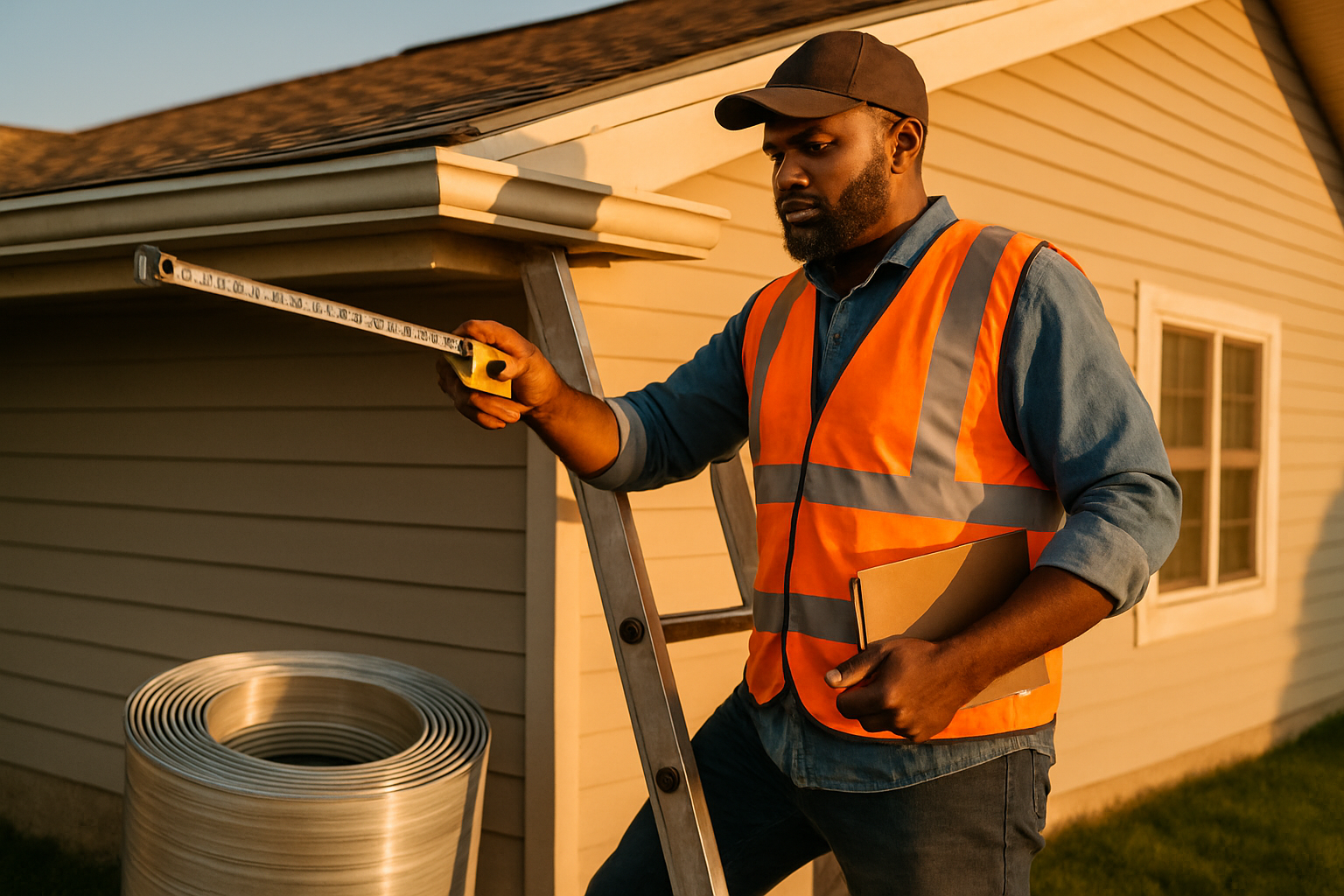
The site visit is where you catch the things that will kill your margin if you miss them. Before you quote anything, do a full walk of every roofline edge and note:
- Roof height and ladder access. A two-story home with a hip roof takes more setup time than a ranch house. If you can't run your ladder at a safe angle, you're renting a standoff or scaffold — that's a separate line item.
- Fascia condition. Pull on the fascia board at several spots around the house. Soft, spongy wood means rot. Rot means board replacement before you can hang gutters, and that's a separate charge.
- Existing gutters. If you're replacing them, note how they're attached. Old spikes pull slower than modern hidden hangers. Estimate removal time as its own task.
- Trees and debris. Heavy canopy or a lot of shingle grit on the roof typically means more time cleaning drop outlets and flushing runs after installation. Factor it in.
- Downspout locations. Count every location where water needs to exit the system. Each downspout run is its own material and labor component.
Take photos as you go. They back up your scope if the customer disputes a line item later, and they make pulling the quote together back at your truck much easier.
How to measure a house for gutter installation
Accurate linear footage is the foundation of your gutter estimate. Here's how to get it right:
Walk each eave run separately. Measure from corner to corner for every run that will hold a gutter. Record each measurement on a rough sketch of the roofline — a simple rectangle or L-shape in your notepad works fine. Don't estimate the total perimeter from memory; measure each run individually so you don't miss a short return or a bump-out over the garage.
Note every corner. Inside corners (where two walls meet at a concave angle) and outside corners (convex, like a bay window) each need either a mitered cut or a drop-in corner piece. Write down each corner type separately — they're priced differently.
Tally downspout runs. For each downspout location, measure the vertical drop from the gutter outlet to the splash block level. Count the elbows the run requires where it kicks away from the building.
Add 5–8% for waste and overage. Seamless stock is cut to length on your machine, but fitting accessories, short cuts, and end caps add real material. Five percent on linear footage is a solid baseline. If the home has lots of short runs or unusual corners, bump it toward eight.
After the site walk, your takeoff should capture at minimum:
- Total gutter linear footage (measured + waste factor)
- Inside corners (count and type)
- Outside corners (count and type)
- Downspout runs (number of runs and total vertical footage)
- End caps needed (one per open run end)
- Hanger and bracket count (from your supplier's recommended spacing)
Build your gutter installation estimate line by line
Breaking your estimate into explicit line items does two things: it makes sure you haven't forgotten anything, and it gives you a defensible document when the customer asks why the job costs $1,800. A vague single-number quote invites negotiation. A detailed estimate invites trust.
Here's a standard structure:
| Line item | Pricing basis |
|---|---|
| Gutter stock (5" K-style aluminum) | Per linear foot |
| Downspout material (2×3 or 3×4 aluminum) | Per linear foot |
| Inside corners | Per piece |
| Outside corners | Per piece |
| End caps | Per piece |
| Hidden hangers and screws | Per piece or per linear foot |
| Elbows and offset sections | Per piece |
| Sealant (tubes) | Per tube (roughly one per 8–10 corner joints) |
| Splash blocks or downspout extensions | Per piece |
| Old gutter removal and disposal | Per linear foot or flat fee |
| Fascia board replacement (if needed) | Per linear foot |
| Labor | Hours × loaded hourly rate |
Material costs vary by supplier and by region, and aluminum coil prices have moved considerably over the past few years. Price from your actual supplier quote before each job rather than relying on a number from last season.
For a sense of how the math stacks up, here's a sample estimate for a 160-LF residential replacement job:
Your actual numbers will differ, but the structure should look similar: materials and labor together making up most of the total, with overhead covering your fixed costs and profit as the line that makes the whole thing worth doing.
How to price downspouts, corners, and add-ons
These components are where margin quietly disappears if you bundle them into a flat per-linear-foot rate instead of pricing them individually:
Downspouts. Don't fold downspout work into your gutter rate. Each run requires separate material, two or three elbows to connect it to the outlet and direct it away from the foundation, and straps to secure it to the wall. Track your time on a few jobs and price each downspout run as a separate unit.
Corners. Mitered corners take longer to cut and seal than a straight run. Drop-in corners are faster but cost more per piece. Either way, price them per piece rather than per foot — the material cost is fixed regardless of the gutter run length on either side.
Fascia board replacement. If you find rot during the site walk, give the customer a separate line item with your price per linear foot for board replacement. Folding it into the gutter rate makes your gutter price look inflated and obscures the actual cost of the repair.
Gutter guards. If you offer guards as an upsell, have a unit price per linear foot ready before you start the job. Customers who see the open gutter channel often decide to add guards on the spot — being able to quote it immediately closes that sale.
If your jobs regularly involve travel beyond your usual area, that time needs to show up in your quotes too. Our guide on how to charge for travel time as a contractor walks through a straightforward way to handle it.
Setting your gutter quote per linear foot as a solo installer
Your per-linear-foot rate is not just the cost of aluminum stock and a few minutes of your time. It has to carry your full loaded cost — labor burden, insurance, truck, tools, and overhead — plus a profit margin that makes the business worth running. Here's how to build it from the ground up:
Start with your true labor cost per hour. The U.S. Bureau of Labor Statistics reports a median hourly wage of $26.65 for roofers and gutter installers as of May 2025. But that's the employee wage figure. As a solo operator, your real cost per hour is higher: you pay both sides of payroll taxes. The IRS sets the self-employment tax rate at 15.3% of your net earnings — the employee and employer portions of Social Security and Medicare combined. Layer on your general liability premium, workers comp coverage, truck payment, fuel, and tool replacement, and your cost per hour typically runs 30–50% above the base wage figure.
Use the markup calculator to run your specific numbers. Plug in your target annual income, the number of billable hours you expect to work, and your overhead costs — it'll give you the minimum hourly rate you need to break even, before profit.
Convert your hourly rate to a per-foot rate. Track your actual installation pace on a handful of jobs: total linear feet installed divided by total hours worked including setup and cleanup. If your pace is 18–22 LF per hour and your loaded cost is $50/hr, your labor cost per foot is roughly $2.30–$2.80. Add your material cost per foot at current supplier pricing to get your floor price. Anything below that floor, you're losing money.
Add your profit margin last. Target margin is added on top of all costs — it is not the same as markup. If your total costs on a job are $800 and you want a 20% net margin, you charge $1,000. The $200 stays in the business.
On material-heavy replacement jobs, collecting a deposit before you order stock protects your cash flow. Our guide on how to collect a deposit as a contractor covers how to structure the ask without pushing customers away.
Takeaways
- Walk every job before writing a number — the site visit is where you find the rot, the two-story setback, and the trees that will slow you down.
- Measure each eave run individually and record every component: linear feet, corners, downspout count, end caps, and accessories.
- Price downspouts, corners, and fascia repairs as separate line items, not folded into the per-LF gutter rate.
- Your loaded labor rate must cover wages, self-employment taxes, insurance, truck, and overhead — then add profit on top of all of it.
- A detailed line-item estimate looks more professional than a single number and is much harder for a customer to compare against a lowball competitor quote.
Build the habit of quoting on paper, not in your head
The contractors who consistently profit on gutter work aren't guessing — they run the same calculation on every job and update only when their actual costs change. Once you've built your first line-item template, the next quote takes ten minutes instead of thirty. JobEstimator was built to speed that process up for solo contractors and small crews, generating itemized quotes in seconds so you spend more time on ladders and less time at a desk. Plans start at $39/mo with no annual contract.
If you price roofing alongside gutters, the roofing quote guide covers the same cost-building logic for shingle and metal work.