How to write a painting estimate step by step
Write a painting estimate that covers labor, materials, and overhead. Step-by-step guide with a sample line-item breakdown for interior repaints.
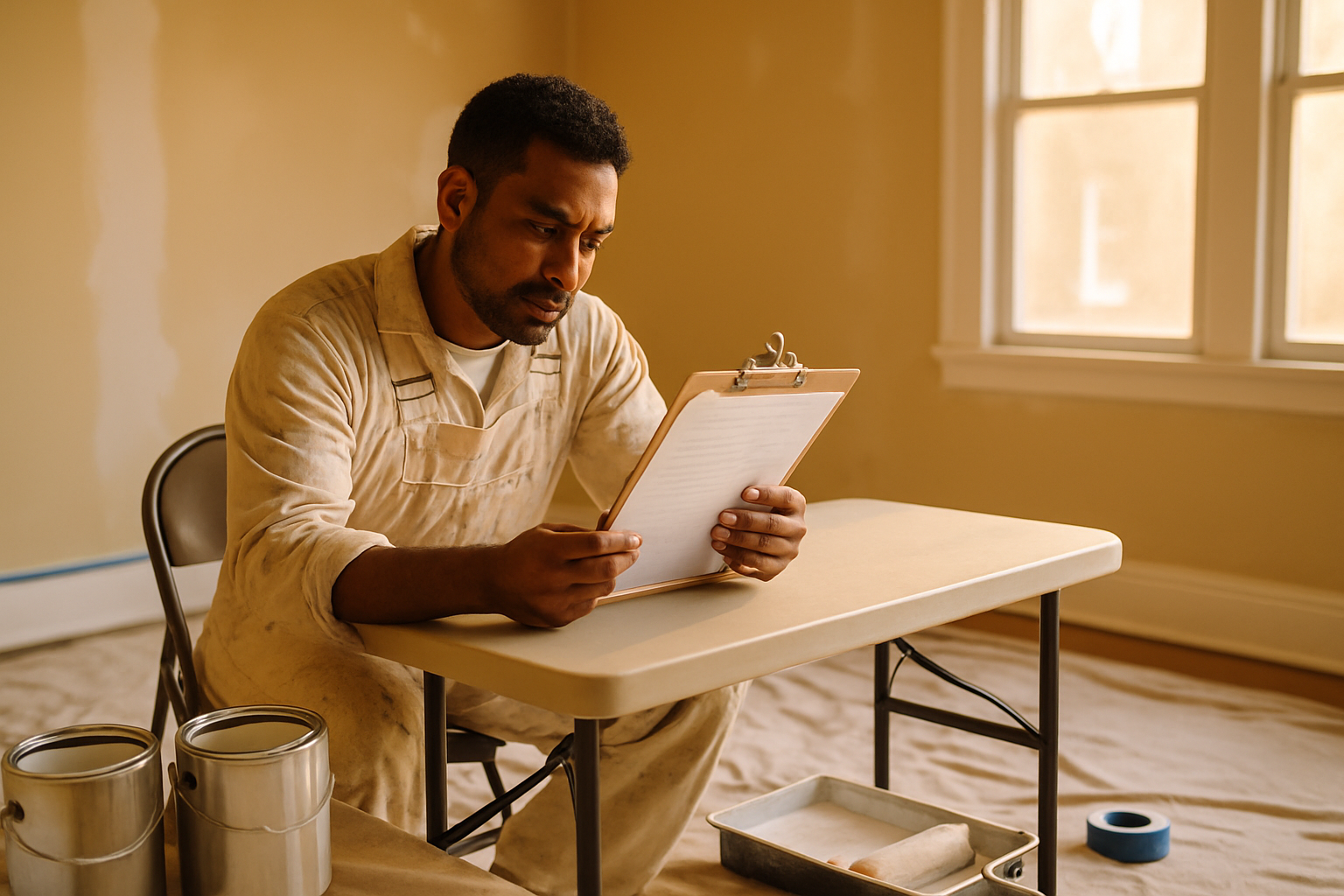
Most painters lose money on quotes in one of two places: they miss scope on the walkthrough, or they don't load the labor rate correctly. Both problems show up as a job that seemed profitable at the quote stage and wasn't by the time cleanup was done. A solid painting estimate fixes both — it forces you to quantify everything before you commit to a price, and it gives the customer something specific enough to say yes to. This guide walks you through building a painting estimate from scratch: how to measure, how to calculate your material and labor costs, and what goes on the document itself.
Start by measuring the paintable surface
The surface area drives every other number in the estimate. Get it right here and the rest of the quote is arithmetic.
For walls, multiply the room's perimeter (the sum of all four wall lengths) by the ceiling height to get gross wall area, then subtract your openings. Standard interior doors are roughly 20 square feet each; standard windows are roughly 15 square feet each. Round down on the subtractions — it's better to have a little extra paint than to come up short mid-job.
| Surface | How to measure |
|---|---|
| Walls | (Perimeter × ceiling height) − (doors × 20 sf) − (windows × 15 sf) |
| Ceiling | Length × width |
| Doors (painted) | Count × 20 sf (both sides, frame included) |
| Baseboards | Linear feet ÷ 10 (rough coverage estimate) |
For a typical 12 × 14 bedroom with 9-foot ceilings, one door, and two windows: perimeter is 52 feet, gross wall area is 468 sf, minus 20 sf (door) and 30 sf (two windows) = 418 sf of paintable wall area. Add the ceiling (168 sf) and you have 586 sf to price for that room alone.
Work through the house room by room and total the figures at the end. That combined square footage number is what you'll carry into the materials and labor calculations.
Surface condition changes your estimate too. Heavy knockdown or orange peel texture increases paint consumption — it doesn't change the measured area, but plan for additional primer or a third coat. Bare drywall, water stains, and smoke damage each add an extra coat of problem-solving. Flag these during the walkthrough and document them in your scope, not after.
Calculate your material costs
Once you have the square footage, materials are straightforward. The product data sheet for any professional-grade interior latex paint lists coverage rate per coat — most premium formulas yield 350–400 square feet per gallon at a single coat. Check the specific can you'll use; coverage varies by finish type and sheen.
For two-coat work (the standard on repaints), divide your paintable area by coverage per coat and multiply by two:
- 1,200 sf ÷ 375 sf/gallon = 3.2 gallons per coat
- 3.2 × 2 coats = 6.4 gallons → order 7
Add a gallon of primer for rooms with bare drywall repairs, stain blocking, or a dramatic color change. Add 10% overage if you're cutting in multiple colors or working rooms with heavy trim detail.
At current market pricing for a quality mid-tier interior latex (approximately $45–$60 per gallon), 7 gallons runs $315–$420 in paint. Budget another $50–$100 for sundries: tape, plastic sheeting, roller covers, roller frame, and brushes.
Mark up your materials before they go on the estimate. A 25–30% materials markup pays for your supply-house run, any returns, and the risk of waste you absorb on a flat-rate job. If you're not sure whether your markup is producing the gross margin you need, run the numbers through the markup calculator — markup percentage and gross margin are not the same number.
Sample materials line for the 1,200 sf job:
- Paint: 7 gallons × $52 = $364
- Primer: 1 gallon × $45 = $45
- Sundries: $75
- Direct materials cost: $484
- With 25% markup: $605 billed to customer
How to calculate labor for a painting quote
Labor is where most painters leave money behind on flat-rate quotes. The fix is to estimate hours first and apply your billing rate second — not to guess a lump sum.
Use production rates. Experienced solo painters roll walls at roughly 150–200 sf per hour including masking and rollout. Ceilings are slower — plan 100–125 sf per hour. Cutting in and trim runs 50–75 linear feet per hour depending on detail level. Prep work (laying drop cloths, masking, patching, sanding) is its own category — budget 1–2 hours per room for a standard repaint, more if you're spackling or cleaning surfaces.
For the 1,200 sf interior repaint:
| Task | Hours |
|---|---|
| Prep (3 rooms × 1.5 hrs) | 4.5 |
| Wall painting (1,200 sf ÷ 175 sf/hr × 2 coats) | 13.7 |
| Ceiling (450 sf ÷ 110 sf/hr × 2 coats) | 8.2 |
| Cutting in and trim | 6.0 |
| Cleanup | 1.5 |
| Total | 33.9 hrs |
Set your billing rate correctly. According to the U.S. Bureau of Labor Statistics, the median annual wage for painters, construction and maintenance was $48,660 in May 2024 — roughly $23 per hour as an employee. As a solo contractor, your billing rate needs to be significantly higher than that to cover workers' compensation, liability insurance, self-employment taxes, vehicle costs, slow weeks, and unpaid quoting time. PayScale data for painting contractors shows established solo operators typically billing in the $55–$75 per hour range before materials, with rates in high-cost metros going higher.
Using $65/hr as a midrange solo contractor billing rate:
34 hours × $65/hr = $2,210 labor
Total estimate for the sample job: $605 (materials) + $2,210 (labor) = $2,815
Before you settle on whether to quote flat rate, hourly, or per square foot, make sure the pricing structure you choose actually covers the numbers above. Our guide on painting contractor pricing models breaks down when each model works and where each one burns you.
Painting estimate line items: what to include on the document
A professional estimate document does two things: it gives the customer a clear price, and it defines exactly what's included so there's no dispute later. Vague estimates create disputes; detailed ones close jobs.
Standard line items for an interior painting estimate:
- Prep work — room by room: move/cover furniture, lay drop cloths, mask trim and fixtures, patch nail holes, spot-prime repairs
- Ceiling — square footage, number of coats, paint product and sheen
- Walls — square footage per room or total, coats, product name, sheen (flat/eggshell/satin)
- Trim, doors, baseboards — describe exactly what's included (both door faces? baseboard only? crown molding? window sills?)
- Cleanup — remove masking, dispose of materials, restore furniture to position
- Terms — deposit amount, payment schedule, quote expiration date, warranty (typically one year on labor)
Itemize by room when you can. Instead of "paint living room — $1,200," write: "Living room walls and ceiling — two coats eggshell latex, patch 4 nail holes, prime bare drywall at TV mount location — $1,450." The specificity justifies the price and closes the loop on what you measured during the walkthrough.
Exclusions matter as much as inclusions. Put a written exclusions list at the bottom of every estimate:
- Wallpaper removal
- Popcorn ceiling removal
- Drywall repair beyond surface-level nail holes and hairline cracks
- Painting behind appliances, in closets, or inside cabinets (unless specified)
- Exterior work
Anything not on the inclusions list becomes a change order when the customer asks for it mid-job. That's not a negotiation — it's the scope you both agreed to in writing.
Takeaways
- Measure room by room before you price. Gross square footage from a floor plan is not the same as paintable wall area. Subtract doors and windows, flag surface conditions, and carry the real number into materials and labor.
- Calculate paint gallons from the product's stated coverage rate, then multiply by the number of coats. Order in full-gallon increments and round up.
- Your billing rate is not the BLS median employee wage. The BLS figure ($23/hr for May 2024) is what painters earn as employees, not what solo contractors need to charge to cover overhead and profit.
- Estimate hours first, then apply your billing rate. Production rates (sf/hr by surface type) give you a defensible hours number you can explain to any customer who asks.
- Write exclusions. Every customer assumes you'll paint what they want painted. An explicit exclusion list is your change-order policy.
Turn your measurements into a quote in minutes
Running the square footage, plugging in labor hours, and applying markup by hand every time you quote takes time that should be running jobs. JobEstimator does the arithmetic automatically: enter room dimensions, set your billing rate, and the estimate calculates in real time. You get a formatted quote ready for a customer signature, with line items already broken out. Plans start at $39/mo — and the first quote usually pays for the month.