How to write a tile installation estimate
A step-by-step guide to writing a tile installation estimate: waste factor, substrate prep, waterproofing, and labor rates for floors and showers.
Tile contractors lose money at the estimate stage, not the installation stage. The job that should have paid well ends up breaking even because the quote missed substrate prep, used the wrong waste factor for a diagonal layout, or priced wet-area work at the same flat rate as a simple floor pour. Knowing how to write a tile installation estimate that captures every real cost — before you commit to a number — is what separates the jobs you make money on from the ones you finish regretting.
This guide walks you through the process from the first site visit to the final line item.
How to write a tile installation estimate: start with a site survey
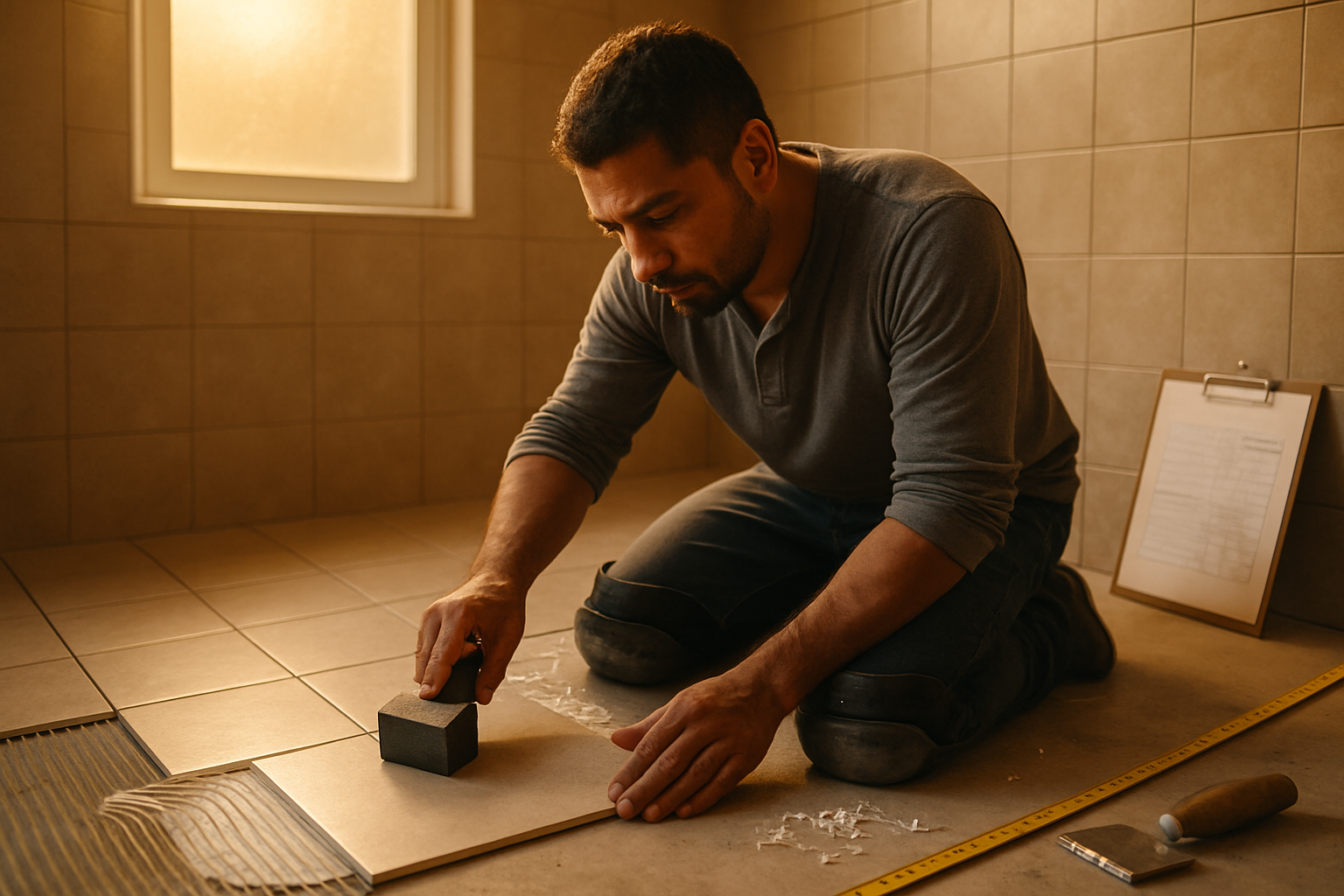
A tile estimate written from memory or a quick photo is a guess. You need six things confirmed on site before you open an estimate document.
- Net tile area. Measure the actual surface to be tiled, not the room dimensions. Subtract permanent fixtures — islands, tub decks, vanities, shower bases, toilet footprints, and anything else that sits on the substrate without tile running underneath it. Net area is what you order material for and what you price labor from.
- Substrate type and condition. Is the base plywood, OSB, concrete slab, or existing ceramic? Is it flat and free of deflection? High and low spots, soft sections, and movement all determine what substrate system the job needs before tile goes down.
- Layout direction and pattern. Straight lay, diagonal (45°), herringbone, or custom pattern? The layout determines the waste factor, which directly changes how much tile you need to order and how long the install takes.
- Wet-area scope. Any shower, tub surround, or steam room requires a waterproofing membrane beneath the tile. Confirm the exact boundaries — they're almost always larger than the homeowner describes. A two-wall tile surround that the customer calls a "simple job" may include a niche, a curb, and a bench seat.
- Existing flooring and demo scope. What's being pulled up? Old ceramic tile over concrete adds significant demo labor compared to LVP on plywood. Existing tile set in a thick mortar bed — common in pre-1990s bathrooms — can turn a half-day demo into a full day.
- Access and haul-off. Third-floor bathrooms, narrow doorways, and no exterior access for debris all add time and cost. Tile debris is heavy — haul-off should be a line item, not something absorbed into your rate.
Write all six down on site. Quoting from memory across multiple jobs per week is how scope exclusions get forgotten before the contract is signed.
How to calculate tile quantity and waste factor
Waste factor is not padding — it's the material that ends up on the floor as cut-offs on every real job. Under-order and you're making a mid-project run to buy tile at retail, often from a different dye lot that won't match. Order right by applying the correct waste factor from the start.
The National Tile Contractors Association publishes installation standards covering waste allowances by layout type. The practical ranges for residential work:
| Layout type | Add for waste | Reason |
|---|---|---|
| Straight lay, parallel to walls | 7–10% | Minimal cuts; standard for floors and walls |
| Diagonal (45° to the wall) | 12–15% | Every perimeter cut is longer |
| Herringbone or chevron pattern | 15–20% | Short cuts accumulate fast |
| Mosaic sheet or complex custom pattern | 20–25%+ | High cut-to-set ratio throughout |
Setting materials are a second line item most estimates undercount. Standard unmodified thinset typically covers 40–50 square feet per 50-lb bag on a flat floor at the recommended trowel notch depth. Grout coverage depends on tile size and joint width — the tile manufacturer's specification sheet gives you the accurate coverage rate for the specific product. Don't estimate grout from memory; a 2×2 mosaic with 1/16-inch joints uses far more grout per square foot than a 24×24 large format with 1/8-inch joints.
Add material quantities to the estimate as separate line items with markup applied. Our markup calculator lets you verify that your material markup is covering overhead before you hand a number to the customer.
The costs that sink tile margins: substrate and prep work
Substrate and prep work are where tile estimates go sideways. These costs are highly variable from job to job and easy to underestimate until you've had one eat your profit.
Demo and disposal. Pulling up old tile adds labor and generates debris that costs money to remove. If the existing tile is bonded with mastic adhesive to a wood subfloor, scraping takes much longer than lifting a floating floor. Factor demo time separately — it's not part of the installation rate.
Substrate repair and leveling. Tile is rigid and unforgiving of subfloor movement. On plywood subfloors, you may need to add blocking, refasten the deck, or install an uncoupling membrane to manage deflection. On concrete, you may need to grind high spots or fill low spots before the tile bond is sound. Self-leveling compound is a material cost most customers don't see coming. Call it out explicitly in the estimate.
Wet-area waterproofing. A shower without a proper membrane system is a callback waiting to happen — and depending on your state, a workmanship liability. Sheet-applied membrane systems (such as those from Schluter Systems or comparable manufacturers) and liquid-applied systems (such as Laticrete HydroBan) add both material and labor cost that belongs on its own line in every shower estimate. This is not an upsell — it's a fixed scope item, and it belongs on the quote whether the customer asks for it or not.
Price each of these components as a distinct line item. Customers accept individual prep costs more readily than they accept a vague upward revision after you've already given a total number.
Tile installation labor rates by job type
The Bureau of Labor Statistics Occupational Outlook Handbook reports a May 2024 median wage of $52,000 per year — roughly $25 per hour — for flooring installers and tile and stone setters. That's the employee wage floor. As a solo contractor, your billing rate must cover self-employment taxes, business liability insurance, workers' comp (if required in your state), vehicle and tools, and overhead — typically driving your effective loaded rate to $55–$80 per hour or more depending on your market and cost structure.
Per HomeGuide's 2026 flooring installation cost data, tile installation labor for residential work runs:
Two factors push labor cost above the floor rate on nearly every real job:
Layout complexity. A herringbone pattern requires more cuts, more resets, and more layout time than a straight lay. Many tile contractors add a surcharge per square foot for diagonal and herringbone work rather than adjusting their hourly rate — it's easier to explain on the quote.
Wet areas and vertical surfaces. Wall tile in a shower runs slower than floor tile. Gravity, precision cutting around fixtures, and the waterproofing scope all extend the job. For complex showers — multiple surfaces, niches, curbs, or benches — many experienced tile contractors price on time-and-materials rather than flat per-square-foot, because the variability is too wide to cover with a fixed price. Our guide to flooring labor cost per square foot has more detail on how tile rates compare across material types.
What every tile installation estimate should include
A tile quote that gets signed and doesn't generate disputes includes these components written out clearly:
- Scope statement. Exact room, surfaces, and boundaries. "Shower floor and three walls of primary bathroom shower to ceiling, including one niche" beats "bathroom tile."
- Tile specification. Who supplies the tile? If the customer is furnishing it, note that clearly, and write what happens if they short-order or damage tiles mid-installation.
- Material line items. Tile (your supply or an allowance), thinset, grout, backer board or membrane system, fasteners, grout sealant. Each with markup applied and quantity noted.
- Labor line items. Demo, substrate prep and leveling, waterproofing membrane, tile installation (by sq ft or flat rate), grout and clean-up, sealer application.
- Explicit exclusions. Plumbing rough-in moves, electrical relocation, painting or drywall, tile furnished by the owner at wrong quantity or wrong specification, structural subfloor repairs outside the identified scope.
- Workmanship warranty terms. What you cover and for how long. For a framework on writing this cleanly, see our guide to writing a contractor workmanship warranty.
For a broader framework of how the estimate structure for tile compares with other flooring types, our flooring estimate guide covers LVP, hardwood, and carpet alongside tile.
Takeaways
- Do a complete site survey before writing any number — net area, substrate condition, layout type, wet-area boundaries, and demo scope are all cost drivers you won't know from a photo or a customer description.
- Waste factor is real math, not a buffer. Use 7–10% for straight lay, 12–15% for diagonal, and 15–20%+ for herringbone and mosaic, per NTCA installation standards.
- Substrate prep and waterproofing are not optional add-ons in wet areas — price them as fixed line items in every shower quote, not as contingency.
- Your billing rate has to cover far more than the BLS median employee wage of $25/hour for tile setters. Load it with taxes, insurance, overhead, and a profit margin before you put a sq ft rate on paper.
- Itemized line items close more jobs and generate fewer disputes than a single lump-sum number — customers can see what they're paying for.
Putting your tile estimate to work
A quote that accounts for every prep step, correct waste, and wet-area scope isn't slower to write — it's more defensible at every step of the sale. When a customer pushes back on price, you can walk them through each line item and show them exactly what they're getting.
JobEstimator is built to help solo contractors write that kind of itemized quote without spending an hour at the desk. Add materials, apply markup, set your labor rates once, and get to the number fast. Plans start at $39/mo with no annual commitment.