Mini-split installation pricing for HVAC contractors in 2026
What to charge for ductless mini-split installations in 2026: labor rates by zone count, equipment markup, and regional benchmarks for HVAC contractors.
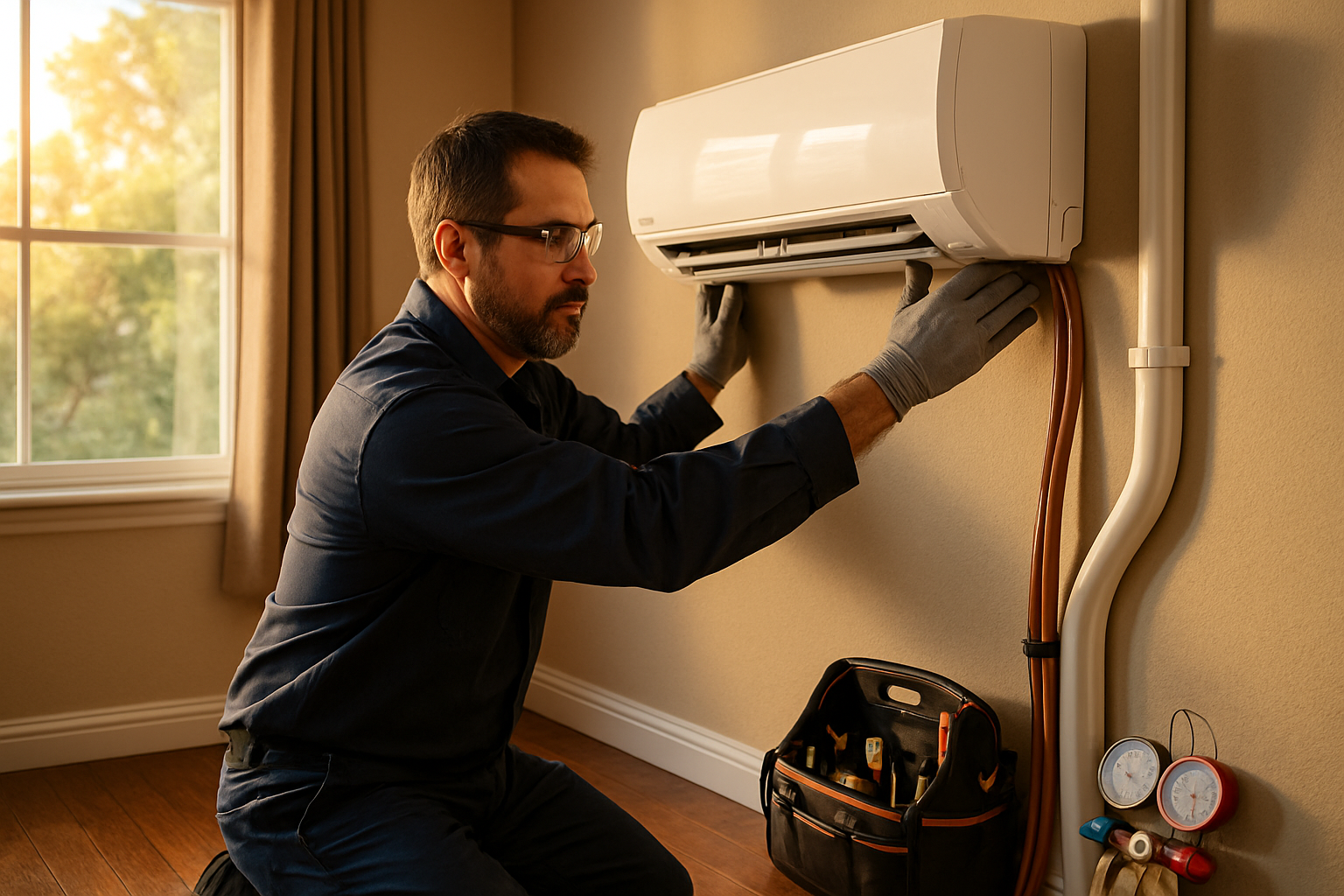
Mini-splits are one of the fastest-growing segments of residential HVAC work, but almost everything written about mini-split installation pricing is aimed at homeowners — not at the contractor who has to build a quote that covers their time, their truck, their equipment cost, and their overhead. This guide flips that. By the end you'll have a framework for pricing single-zone and multi-zone mini-split installations, a method for calculating your loaded labor rate, and a clear-eyed look at the complexity factors that can quietly turn a four-hour job into an eight-hour day. If you want a step-by-step walkthrough of the pricing formula itself, the mini-split installation pricing how-to guide covers the calculation in detail; this post focuses on market benchmarks and what contractors are actually charging.
Mini-split installation pricing benchmarks for 2026
The table below shows typical contractor-billed ranges for ductless mini-split work, broken out by zone count. The labor column is what you charge for installation labor alone; the total-installed column includes equipment, labor, refrigerant, line set materials, and permit fees where applicable. Consumer pricing platforms including Angi and HomeGuide track homeowner invoices across the country and consistently land in these ranges for standard residential work.
| Zone count | Labor charge (billed) | Total installed (homeowner invoice) | Notes |
|---|---|---|---|
| 1 zone (9,000–18,000 BTU) | $500–$1,200 | $2,200–$5,000 | Surface-mount line set, standard circuit |
| 2 zones | $1,000–$2,200 | $4,500–$9,500 | One additional head, 15–25 ft added line set |
| 3 zones | $1,600–$3,200 | $7,500–$14,000 | Larger outdoor unit may be required |
| 4 zones | $2,200–$4,500 | $10,000–$18,500 | Full-day crew or two-day solo job; permits likely |
These ranges assume surface-mounted line sets, no electrical panel work, and standard ceiling-height walls. If any of those assumptions don't hold — and they often don't — your labor charge goes up. The "What drives mini-split labor costs higher" section below covers the common add-ons.
How to build your loaded labor rate for mini-split work
The single biggest variable in any mini-split pricing framework is your hourly billing rate. Use someone else's number and you're either leaving money on the table or pricing yourself out of jobs you should be winning.
Start from the labor cost floor. The U.S. Bureau of Labor Statistics May 2025 Occupational Employment and Wage Statistics puts the national median hourly wage for HVAC mechanics and installers at $32.75. That's a wage figure — what a tech earns at a shop. Your billing rate needs to be higher, because it also has to cover payroll taxes, workers' comp, general liability insurance, truck depreciation, tools and manifold gauges, and a share of your fixed overhead. For a solo HVAC contractor or small shop, that loaded billing rate is typically 2.0–3.0 times the raw tech wage, or roughly $65–$100 per billed hour in most markets. If you haven't run the math on your own number, the minimum hourly rate calculator will give you a defensible floor in about five minutes.
Once you have your hourly rate, multiply it by realistic on-site hours. The Furnace Outlet's mini-split installation guide breaks down installation time by zone count: a straightforward single-zone installation with surface-mounted line sets typically runs 4–6 hours. Each additional zone adds roughly 4–5 hours when the line set routing is clean. Here's how that plays out at a $80/hour loaded billing rate:
| Zones | Estimated hours | Labor charge at $80/hr |
|---|---|---|
| 1 | 5 | $400 |
| 2 | 9 | $720 |
| 3 | 14 | $1,120 |
| 4 | 19 | $1,520 |
Your markup on top of that labor cost — to cover overhead, profit, and business risk — is why the "labor charge" column in the first table runs higher than this raw calculation. The $80/hr rate is your floor; your billing rate to the customer should be the loaded rate that includes your target margin, not just break-even.
How to mark up mini-split equipment
Mini-splits are capital equipment — a single 12,000 BTU outdoor unit from a major manufacturer retails anywhere from $700 to $2,500 depending on brand and SEER rating, and a multi-zone outdoor unit can easily run $2,000–$4,000 at your distributor. Equipment markup on these installs works differently than markup on a $15 capacitor or a $45 thermostat.
Mini-split equipment markup works differently than markup on small repair parts. At a $15 capacitor you might double or triple the part cost without a customer blinking — at a $1,800 outdoor unit, customers are more likely to have checked prices online. Most contractors respond by applying a lower percentage markup to large equipment while relying on labor margin and total-job margin to carry the work. A 30% markup on a $1,800 unit adds $540 to your ticket; a 30% markup on a $400 part adds $120. The percentage is the same but the risk is asymmetric — customers flag equipment overpricing more readily than labor overpricing. For benchmarks on what HVAC contractors are actually targeting in total gross margin, the gross margin guide for trade contractors has the data broken out by trade and job type.
A few things to keep in mind when you build your equipment line:
- Quote from your distributor's current price sheet, not from memory. Mini-split unit pricing has moved with supply chain conditions, and a three-month-old quote sheet can cost you margin.
- Separate equipment from labor in your quote — at least internally. It protects you if a customer supplies their own unit (a rising trend). If they supply the unit and it has a warranty claim, you're the one on-site; price your labor accordingly and spell out the warranty terms in writing.
- Include refrigerant line set materials as a separate line item. Pre-flared line sets, line covers, and mounting hardware add meaningful material cost — extended runs or concealed installations add considerably more. Under-quoting line set materials on a multi-zone job with long runs is one of the fastest ways to bleed a job.
See the AC replacement pricing guide for a detailed breakdown of the two-part formula (labor + equipment) that applies equally well to mini-split installs.
Multi-zone mini-split pricing: what changes as you add zones
Adding zones is not linear. A two-zone job is not just double a one-zone job.
Outdoor unit sizing is the first variable. A single mini-split outdoor unit can typically serve up to three or four zones, but as you add heads, you may need a larger outdoor unit or a multi-zone-capable inverter system, both of which cost significantly more at the distributor. Check the manufacturer's pairing requirements before you quote.
Line set routing complexity multiplies with zone count. On a single-zone job, you're typically running one set of lines from the outdoor unit to a single indoor head. On a four-zone system, you may be routing line sets to four different rooms, which means more wall penetrations, more line covers or in-wall runs, and more time measuring and cutting.
Permit requirements vary by jurisdiction, but multi-zone systems with higher BTU ratings are more likely to trigger permit thresholds. Factor in permit pull time and a likely inspection visit when you schedule the job — confirm local permit costs before committing to a timeline.
For a deeper look at how flat-rate vs. time-and-materials pricing affects your exposure on complex multi-zone work, the HVAC service call pricing guide covers the tradeoffs — the same logic applies to installation jobs when scope is uncertain.
What drives mini-split labor costs higher
The benchmark ranges above assume a clean install: standard wall height, easy outdoor unit placement, surface-mounted line sets, and an existing dedicated circuit. Here's what adds time and should add dollars to your quote:
- Concealed line sets (routed inside walls or through the ceiling): adds 2–4 hours per zone according to The Furnace Outlet's installation data. Plan for drywall patching or a subcontractor coordination cost.
- Second-floor or attic outdoor unit placement: adds 1–2 hours for safe equipment handling and requires additional rigging or a second person on-site.
- Electrical panel upgrade or new dedicated circuit: if the home doesn't have a suitable circuit, adding one adds meaningful time and material cost. Sub this out to a licensed electrician or build it into your quote if you're a licensed dual-trade contractor. Either way, treat it as a separate line item — electrical work on a mini-split job is a scope item, not a courtesy.
- Long line set runs beyond standard 25 feet: every 10 feet of additional line set adds materials and installation time. Some manufacturers have maximum line set length limits that affect system performance — know those specs before you quote.
- EPA Section 608 certification requirements: all refrigerant handling on traditional mini-splits requires a 608-certified technician. If you're using a non-certified helper on-site, factor in the fact that only your certified tech can do the refrigerant work, which can create scheduling bottlenecks on multi-zone jobs.
Takeaways
- Mini-split installation pricing is driven by three inputs: your loaded billing rate, hours on-site, and equipment markup. Build your quote from those inputs rather than borrowing a number from a competitor or a homeowner pricing guide.
- The BLS May 2025 national median HVAC wage is $32.75/hour. Your billing rate should be 2–3× that to cover overhead, taxes, insurance, and a profit margin.
- A standard single-zone installation (surface-mount, existing circuit) runs 4–6 hours. Multi-zone jobs scale at roughly 4–5 hours per additional zone under clean conditions.
- Keep equipment and labor as separate line items internally even if you present a flat-rate total to the customer. High-ticket equipment invites customer price comparisons — price labor firmly and apply a reasonable equipment margin without anchoring to a fixed percentage.
- Concealed line sets, panel work, and second-floor placements are the three most common sources of scope creep on mini-split jobs. Price them explicitly — they add real hours.
Stop quoting mini-split jobs from memory
Mini-split installs are high-ticket, time-sensitive jobs. A quote that's off by $400 on a $5,000 install is only an 8% error, but it can represent two hours of labor you didn't bill. JobEstimator builds quotes in minutes rather than hours, pulling your labor rate, markup, and complexity factors into a complete ticket — no spreadsheet required. Plans start at $39/mo. If you're doing three or more mini-split installs a month, the time you save on quoting pays for it in the first week.