How to price EV charger installation as an electrician
How to price EV charger installation as an electrician — labor hours, materials markup, permit fees, and when your customer needs a panel upgrade first.
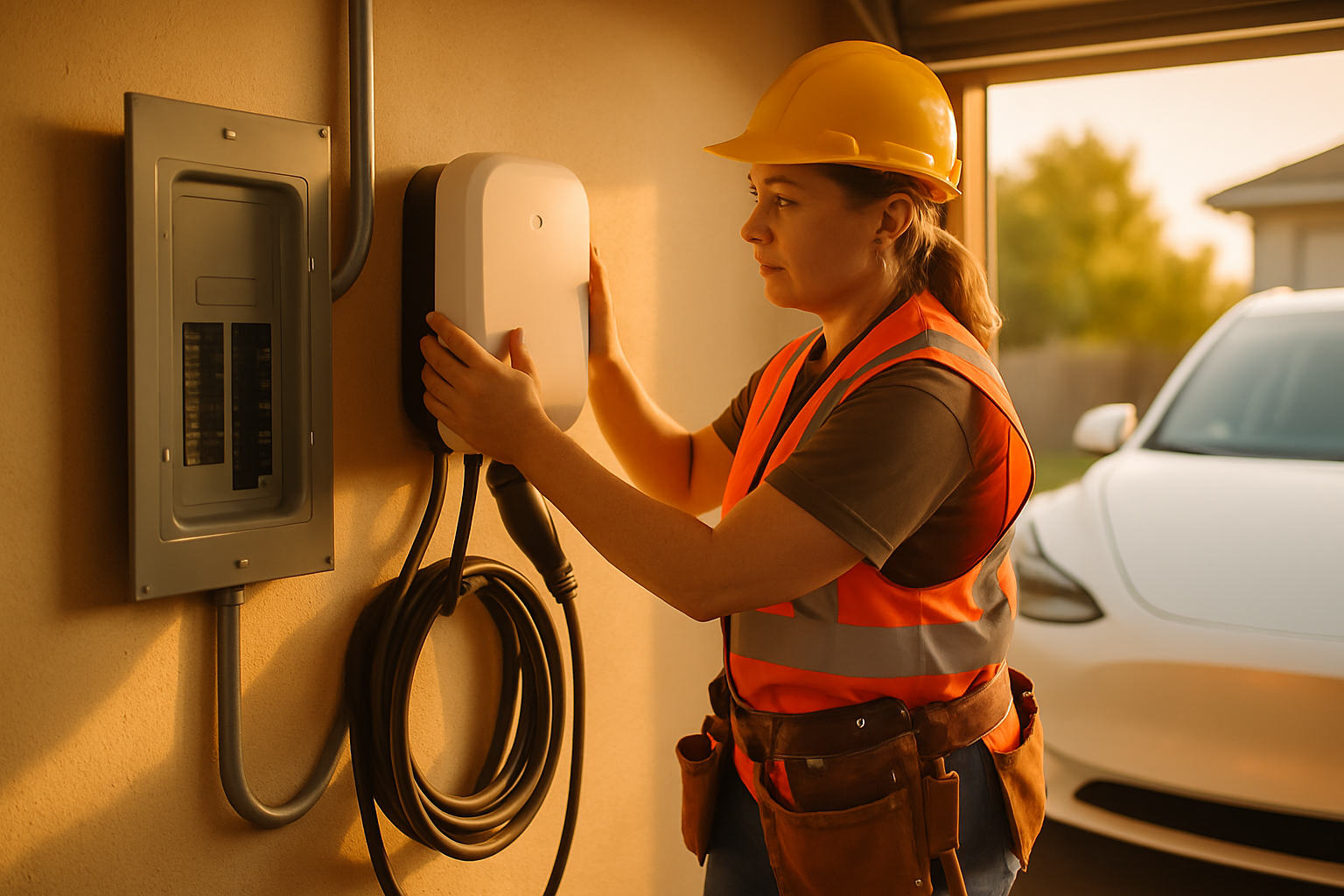
Every guide on how to price EV charger installation seems to be written for the homeowner — they want to know what to budget before they call you. What you need is a price built from the bottom up: your labor hours, your material cost with markup, the permit fee your local AHJ charges, and a clear answer to the question every customer will eventually ask — "do I need a panel upgrade first?" Get those inputs right and you'll quote EV charger jobs profitably from the first one, instead of learning the hard way what you missed.
This guide covers Level 2 residential EV charger installation — the job that actually lands in your queue.
What a Level 2 EV charger installation actually includes
Not all EV charger calls are the same job. The three levels of charging are defined by voltage and amperage:
- Level 1 (120V, up to 12A) uses a standard outlet. No dedicated circuit work needed. You're rarely called for this.
- Level 2 (240V, 40–50A) is the standard residential install — a wall-mounted EVSE unit powered by a dedicated circuit from the panel. This is the job this guide prices.
- Level 3 / DC Fast Charge (480V, three-phase) is commercial infrastructure. Residential customers aren't calling you for this.
A typical Level 2 install includes these components:
- A dedicated 240V branch circuit from the panel (40A or 50A depending on the EVSE)
- Wire run from the panel to the charging location — length and routing vary significantly
- Conduit where required by your jurisdiction or run location (interior vs. exterior, finished vs. unfinished walls)
- Wall-mounted EVSE unit — customer-supplied or contractor-supplied; agree on this before quoting
- Panel assessment — is there an open breaker slot?
- Permit pull and inspection
The single biggest cost driver is the wire run. A garage six feet from the sub-panel is a fundamentally different job than a run through 60 feet of conduit across an unfinished basement and an exterior wall. Scope it before you quote.
How long does EV charger installation take?
The time range for a residential Level 2 install is wide because run length, mounting location, and panel condition all vary. A practical framework:
| Job scenario | Typical labor hours |
|---|---|
| Open panel slot, garage adjacent to panel, run under 20 ft | 2–3 hrs |
| Open panel slot, garage on opposite end of home, 30–60 ft run with conduit | 4–6 hrs |
| Panel full — load management device or tandem breaker solution required | 5–8 hrs |
| Full panel upgrade needed before charger can be installed | 10–16 hrs (panel job, then charger) |
These ranges assume one electrician and a standard residential scenario. Working with an apprentice on longer runs shortens the clock hours but you'll account for that in your labor calculation.
Your labor cost starts with your loaded shop rate — not the BLS wage data. The U.S. Bureau of Labor Statistics reports a median hourly wage of $34.37 for electricians as of May 2025. As a solo operator, your actual billable rate covers everything an employer normally absorbs: self-employment tax, workers' comp, general liability, vehicle and tools, and non-billable hours for estimates and drive time. Most solo electricians find their floor rate lands between $75 and $105 per hour before adding any profit margin. If you haven't built your rate from your actual overhead numbers, the full formula is in our guide on how to calculate your minimum hourly rate as a solo contractor.
At $90 per hour and a 4-hour moderate install, your labor input is $360. That's not your price — it's one of four inputs.
How to price EV charger installation materials and apply markup
The core materials for a standard Level 2 install:
- Double-pole breaker — 40A or 50A depending on the EVSE nameplate rating
- Wire — 8 AWG copper for a 40A circuit, 6 AWG copper for 50A, sized per the National Electrical Code (see permits section below)
- Conduit and fittings — where exposed runs, exterior locations, or your AHJ require it
- EVSE hardware — if you're supplying it, common residential units run $300–$700 at supply house pricing depending on amperage and features
- Miscellaneous — wire staples, junction boxes, weatherproof covers, breaker lockout hardware
Quote all materials at your selling price — supply house cost plus your markup. A 35–40% markup is standard for residential electrical materials. It covers the sourcing labor, supply-house run, and the parts warranty you're taking on. Use the free markup calculator to confirm that your markup percentage produces the gross margin you intend: a 40% markup is only a 28.6% gross margin, not 40% — the distinction matters when you're checking whether your quotes are profitable.
If the customer is supplying their own EVSE unit, charge a handling and coordination fee — typically 10–15% of the unit's value — and add language to your quote excluding parts warranty on customer-supplied equipment. You're still assuming risk on the wiring even if you didn't sell the charger.
Does your customer need a panel upgrade first?
EV charger installation is one of the most common triggers for a panel upgrade conversation. Look for these conditions during your site walk:
- Panel is full — no open breaker slots, and no tandem-compatible positions where a slimline breaker would fit
- Service is 60 or 100 amps — a Level 2 charger plus existing load may push total demand to or past service capacity; a load calculation will tell you
- Panel is aging or damaged — Federal Pacific Stab-Lok, Zinsco/Sylvania, visible heat damage, or deteriorated insulation around conductors
If any of these exist, the panel upgrade conversation happens before you quote the charger — not after. Surprising a customer with "this is actually a $2,200 job, not an $800 job" after they've agreed to a price is a dispute waiting to happen. Add a contingency clause from the first visit: "Quote is contingent on the panel having available capacity. If a panel upgrade is required, pricing will be provided as a separate line item."
For the full breakdown on what goes into a panel upgrade price — labor, materials, permit, and a worked example — see Electrician panel upgrade pricing: what to charge in 2026.
One alternative worth knowing: a load management device (sometimes called a smart EV breaker or sub-panel load controller) can allow EV charger installation on a full panel by dynamically sharing capacity with a high-draw circuit like HVAC or a dryer. Price these as their own line items and document the operational limitations in writing — the customer needs to understand what conditions will throttle their charging speed.
Permits, NEC requirements, and the customer tax credit worth mentioning
Every Level 2 residential EV charger installation requires a permit in virtually every U.S. jurisdiction. The governing standard is NFPA 70 (the National Electrical Code), specifically Article 625, which covers electric vehicle power transfer systems. NEC 625.40 requires that the branch circuit for EVSE installed in dwelling units be rated at not less than 40 amperes — which is the technical basis for why these installations always require a new dedicated circuit.
Permit fees vary widely:
- Rural and small municipalities: $75–$150
- Mid-size cities: $100–$250
- High-cost metros (California, New York, Washington DC area): $250–$500 or more
Always quote permit fees as a pass-through line item at cost. Never bury them in overhead. Call the local building department before your first quote in any jurisdiction you haven't permitted before — five minutes on the phone prevents a $300 surprise on a job you've already won.
One more thing worth mentioning to customers during the site visit: under IRS Section 30C, homeowners can claim a 30 percent federal tax credit on the cost of residential EV charging equipment and its installation — up to $1,000. You're not their tax advisor and shouldn't quote a net price assuming the credit, but pointing it out helps hesitant customers move forward without you having to discount your work.
How to price an EV charger installation: worked examples
Here's how the inputs stack up on two common residential scenarios. Adjust every figure to your loaded rate and local permit costs.
| Line item | Simple install | Complex install |
|---|---|---|
| Labor (hrs × $90/hr loaded rate) | 2.5 hrs = $225 | 6 hrs = $540 |
| Wire, breaker, conduit, hardware | $180 → $243 billed (35% markup) | $390 → $527 billed (35% markup) |
| EVSE unit (contractor-supplied) | Customer-supplied | $450 → $608 billed (35% markup) |
| Permit (pass-through at cost) | $100 | $175 |
| Total quote | $568 | $1,850 |
The simple job — a short run, a panel with an open slot, and a customer-supplied charger — comes in under $600. The complex job with a longer conduit run and a contractor-supplied EVSE unit pushes toward $1,900. Consumer-facing websites quoting $400–$800 for an "average EV charger installation" are using data that mixes side-work pricing, regional outliers, and jobs where the EVSE was not included. Your number is different because it's built from your actual costs.
Takeaways
- Level 2 (240V, 40–50A dedicated circuit) is the standard residential EV charger job — scope the wire run length and panel capacity before quoting anything.
- Labor runs 2–3 hours on a simple install, 6+ hours on a complex run; price it at your loaded shop rate ($75–$105/hr for most solos), not the BLS median employee wage.
- Mark up materials 35–40%; apply the same markup to contractor-supplied EVSE hardware, and charge a 10–15% handling fee when the customer supplies their own unit.
- NEC 625.40 (NFPA 70) requires a minimum 40A dedicated circuit for EVSE in dwelling units — know the code before your inspector does.
- Quote permit fees as a pass-through line at cost; call your AHJ before your first quote in a new jurisdiction.
- If the panel is full or undersized, surface it on the site visit — not after the customer signs.
Get your EV charger quote out before the competition calls back
Homeowners installing EV chargers are often leaving messages with two or three electricians and taking whoever calls back first with a real number. A professional, itemized quote that lands the same day the customer calls already outperforms most of your competition — without touching your pricing.
JobEstimator builds the labor, materials, markup, and permit line items for an EV charger installation in under two minutes. Plans start at $39/mo, and a single job where your markup is structured correctly usually covers the cost. Before your next quote goes out, run your numbers through the free markup calculator to make sure the margin you think you're making is the margin you're actually keeping.