Tile labor rates by job type: floor, shower, and backsplash 2026
What tile setters charge in 2026 for floor, shower, and backsplash jobs—rate benchmarks by job type, tile size, and layout complexity.
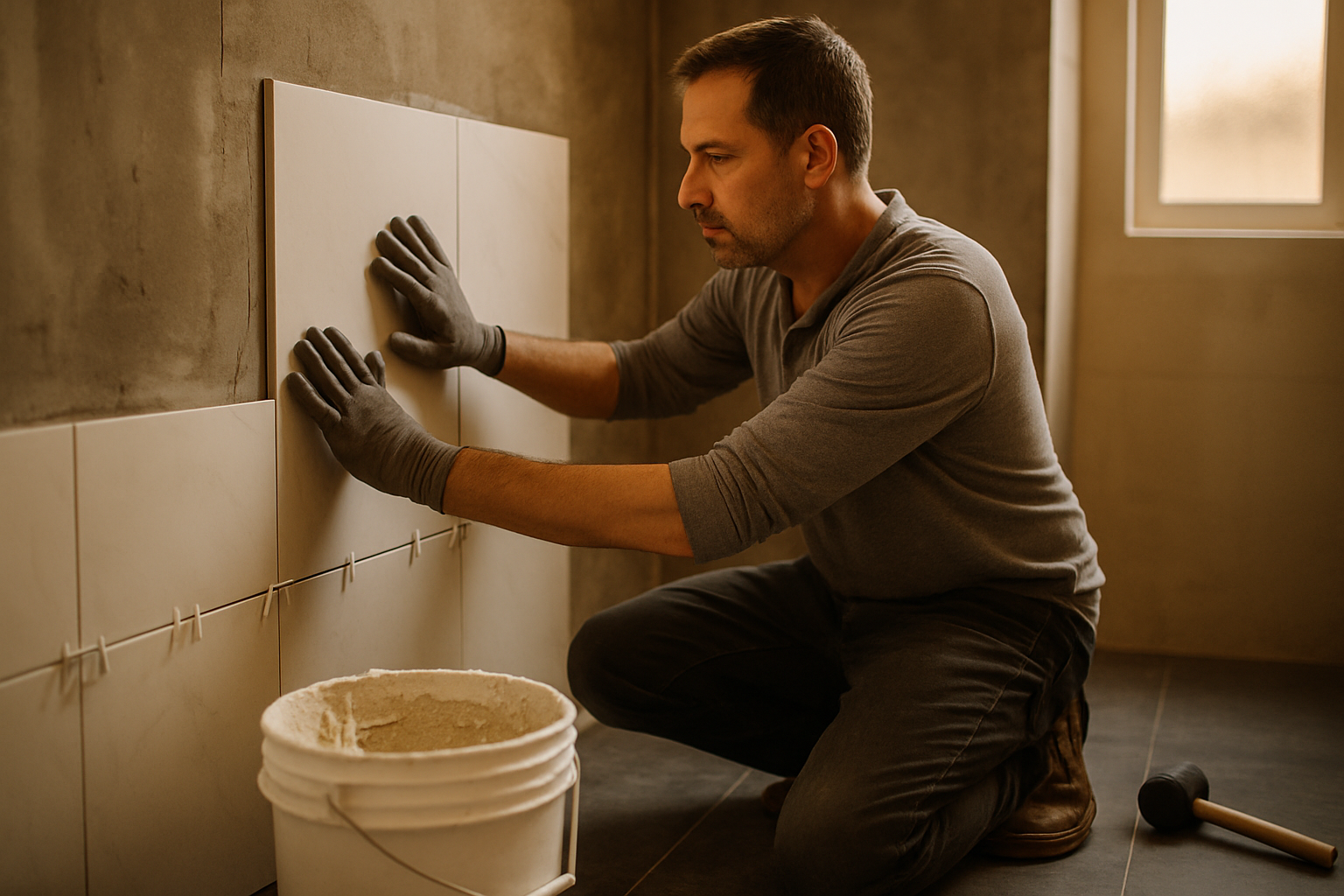
Most tile contractors set one labor rate and apply it to every job. A ceramic floor in a laundry room and a three-wall shower with a niche and a bench are both "tile work," but the labor math is completely different. Pricing them the same way means you make good money on the easy jobs and bleed margin on the complex ones. This post breaks down what tile contractors are actually charging by job type in 2026 — floor, shower, and backsplash — so you can set a different rate for each and stop letting your hardest jobs subsidize your easiest ones.
Floor tile installation labor rates in 2026
Floor tile is where most tile contractors anchor their rate because it's the most predictable job type. Production rates are consistent on flat, prepped substrate, and the scope is usually well-defined before you start.
Per HomeGuide's 2026 flooring installation cost data, labor-only rates for residential tile floors run:
| Tile type | Labor per sq ft (2026) |
|---|---|
| Ceramic (standard, straight lay) | $5 – $8 |
| Porcelain (denser material, harder to cut) | $6 – $10 |
| Natural stone (marble, slate, travertine) | $8 – $15 |
The spread inside each row is where mistakes happen. The low end assumes prep-ready substrate, a simple rectangular room, and a straight layout. Diagonal layout, soft subfloor that needs leveling compound, transitions to other flooring, or stair work pushes you toward the top of the range before the tile is even down.
The U.S. Bureau of Labor Statistics Occupational Outlook Handbook reports a May 2024 median wage of $52,000 per year — roughly $25 per hour — for tile and stone setters. That figure is an employee wage, not a contractor billing rate. As a self-employed tile setter, your loaded cost includes self-employment taxes, liability insurance, vehicle and tool expenses, and overhead — typically pushing your true internal cost to $55–$80 per hour depending on your market before any profit. Your per-square-foot floor rate needs to recover that cost at your actual production speed, not some hypothetical crew from a national average.
For a detailed walkthrough of building your hourly rate from the BLS wage floor, see our flooring labor cost guide — the methodology applies equally to tile work.
Why shower tile labor rates run 2–3x floor tile
The most common pricing mistake tile contractors make is quoting shower work at the same per-square-foot rate as floor work. The materials are often identical. The labor cost is not.
Per Angi's 2026 shower tile cost data, shower tile installation labor runs $12 to $22 per square foot for standard residential work, compared to $6–$10 per square foot for a comparable porcelain floor. Three factors explain the gap:
Vertical surface production rate. Wall tile sets slower than floor tile. You're working against gravity on every piece, mortar coverage is harder to verify at a glance, and alignment tolerances are stricter because the finished surface is at eye level rather than underfoot.
Mandatory waterproofing scope. Every shower requires a waterproofing membrane system beneath the tile. The National Tile Contractors Association publishes installation standards that make membrane systems non-negotiable in wet areas. Sheet-applied or liquid-applied, the membrane adds material cost and a distinct labor step — mixing, rolling or taping, cure time before tile goes down — that belongs on its own line in every shower quote.
Precision cuts at fixtures and penetrations. A standard 60-square-foot three-wall shower has a valve body, a showerhead rough-in, a drain, and usually at least one niche. Each penetration requires a precise cut. On a simple floor, most cuts run along straight walls; in a shower, the high-tolerance cuts cluster where mistakes are most visible.
For complex showers — multiple surfaces, a curb, a bench, a pebble-tile floor, and detailed accents — many experienced tile contractors move to time-and-materials rather than flat per-square-foot pricing. The job-to-job variability is too wide to cover with a fixed number and protect margin.
Large-format tile: what the size premium actually costs you
Large-format tile — 24×24 and larger, including the increasingly popular 48×24 and 24×48 slab formats — commands a labor premium over standard-format work of the same material. The reason is mechanical: each piece must sit within a tight tolerance of adjacent pieces to prevent lippage, and on most substrates that requires a tile leveling system.
Leveling clips and wedges slow production in two ways. First, you work in sections, letting mortar firm up before moving to adjacent rows so the clips can do their job. Second, back-buttering large pieces takes longer than back-buttering 12×12 tiles, and heavier pieces need suction cups or a second set of hands to position safely without shifting already-set tiles.
As a practical matter, large-format porcelain floor work commands a meaningful labor premium over the $6–$10 range that HomeGuide's 2026 flooring cost data shows for standard porcelain. On wall applications — large-format tile in showers or feature walls — that premium stacks on top of the already-elevated wall rate.
Before you commit to a per-square-foot price on a large-format job, run the numbers through a markup calculator to confirm your rate actually recovers your loaded hourly cost at your real production speed for that tile format. What looks like a minor format difference often hides a meaningful production difference.
Backsplash and feature wall tile: small area, higher rate per square foot
Kitchen backsplashes and decorative feature walls are small-area jobs that consistently run more in labor per square foot than comparable floor work in the same material. Three reasons:
Setup costs don't scale with area. Moving in, protecting adjacent surfaces, laying out the pattern, and cleaning up takes roughly the same time on a 30-square-foot backsplash as on a 60-square-foot one. Small jobs carry proportionally more overhead time.
Cut count is high relative to area. Kitchen backsplashes are rarely open runs. Every outlet, switch plate, cabinet door edge, and window sill requires a partial tile. A 40-square-foot backsplash can have 25 or more precision cuts, which accumulates faster than the square footage suggests.
Visibility is total. Unlike a floor, a kitchen backsplash is at eye level, back-lit by task lighting, and scrutinized up close every time someone cooks. Grout joint uniformity and level cuts at cabinet edges leave no margin for error.
Per Angi's 2026 tile installation cost data, wall tile labor runs toward the upper end of the installation range — typically $10–$20 per square foot for standard subway tile backsplash work, with the top end applying to intricate patterns or premium materials. For mosaic sheet tile or decorative medallion work with high cut counts, many tile contractors move to hourly billing — the cut-to-set ratio is too variable to price accurately per square foot.
Line items that don't belong inside your sq ft rate
The tile rate — per square foot or hourly — is one piece of the bid. These items routinely get absorbed into it when they should stand alone:
- Demo and disposal. Pulling up existing tile is a separate scope. Price it by time, not by the square footage of new tile going in.
- Substrate prep and leveling. Self-leveling compound, backer board installation, grinding high spots, and dealing with deflection are real costs with real time. Call each one out.
- Waterproofing membrane (all wet areas). Material plus application labor. This is not an upsell — it's a fixed scope item in every shower bid regardless of what the customer asks for.
- Setting materials with markup. Thinset, grout, board fasteners, and sealer are material costs that should carry markup before they hit the invoice total.
- Haul-off. Tile demo generates heavy debris. Disposal belongs on its own line.
Our tile installation estimate guide has the full line-item structure and what each component should include in a signed quote.
Takeaways
- Floor tile labor runs $5–$15 per square foot depending on material and layout per HomeGuide 2026 data — ceramic on a flat, straight-lay floor is at the low end; natural stone on a complex layout is at the top.
- Shower tile labor runs $12–$22 per square foot per Angi's 2026 shower cost data — two to three times the equivalent floor rate — because of mandatory waterproofing, slower vertical production, and precision fixture cuts.
- Large-format tile (24×24 and larger) adds a meaningful premium over standard-format work of the same material; leveling systems and heavier pieces slow production rate in ways that per-sqft pricing must reflect.
- Backsplash and feature wall work runs $10–$20 per square foot in labor; a small area doesn't mean a proportionally lower rate when setup costs and cut count are high.
- The BLS May 2024 median wage of $52,000 per year ($25/hr) for tile and stone setters is an employee wage, not a contractor billing rate — fully-loaded internal cost is typically $55–$80/hr before profit.
- Demo, waterproofing, substrate prep, setting materials, and haul-off belong on separate lines in every bid rather than buried inside the installation rate.
Setting your rates before the next bid comes in
Tile work is one of the few trades where the same skill and the same tile can produce wildly different amounts of revenue depending on what surface it's going on. A floor rate applied to a shower loses money; a shower rate applied to a large-format floor wall leaves competitive bids on the table. The fix is having a distinct rate for each job type before a customer calls.
JobEstimator is built to store your separate labor rates by job type, apply markup to materials automatically, and generate an itemized quote without redoing the arithmetic on every call. Plans start at $39/mo — if you're running tile jobs most weeks, the margin protection on one repriced shower job covers a year of it.